Explore the Screenplay That Brings Guillermo Del Toro’s Vision of Mary Shelley’s Gothic Monster to Life
Since its strong reception in Venice, Frankenstein has garnered significant attention in the early awards season, achieving 11 nominations and four wins at the Critics Choice Awards. Among its noteworthy accolades are five nominations at the Golden Globes, including Best Picture and Best Director, and a nomination from SAG-AFTRA’s Actor Awards for its ensemble cast. Additionally, the film has secured 11 mentions across craft categories in the Oscar shortlists. Actor Jacob Elordi has received recognition with a Critics Choice Award win and a nomination, alongside Oscar Isaac, for the Golden Globes.
Director Guillermo del Toro also received a nomination from the USC Scripter Awards, which honors writers of adapted scripts alongside the original works they are based on. Earlier today, he earned a nomination for the Directors Guild Awards.
Watch on Deadline
After decades in development, del Toro’s Frankenstein fulfills the filmmaker’s lifelong ambition to adapt Mary Shelley’s 1818 gothic classic. Departing from earlier adaptations, this version shifts the narrative focus from Victor Frankenstein to his creation, reimagining “The Monster” as “The Creature,” and dedicating the film to their dual perspectives and experiences.
The narrative centers on Victor, a brilliant but ego-driven scientist who seeks to conquer death by creating new life. His monstrous experiment leads to tragic consequences for both himself and his nameless creation. The storyline takes audiences from the frozen Arctic tundra to the harrowing battlefields of 19th-century Europe as both Frankenstein and The Creature embark on separate quests for meaning.
Victor is portrayed as a complex character, described by del Toro as a tyrant who sees himself as a victim, disregarding the lives he ruins while lamenting his fate. Isaac and del Toro reimagined Victor less as a traditional scientist and more as a “misunderstood artist” with a “punk rock energy,” viewing his laboratory as a stage for provocative endeavors. At the beginning of the story, Victor exists in a “monstrous” state, barely clinging to life on the arctic tundra. His motivations stem from an ego-driven desire to create new life, charting a path from an uncompromising visionary to a broken, defeated genius.
The Creature is initially introduced as a terrifying monstrosity, who later recounts his own version of creation, positioning both characters as protagonists in the film.
At its core, the film is a humanistic and existential drama that delves into profound, universal themes. Del Toro’s adaptation revisits the tale to explore the essence of humanity—our desires for love and the experience of being misunderstood as a creator, a creature, a father, and a son. The narrative examines inherited trauma and questions the nature of good and evil. While it may not conform to conventional horror, del Toro describes it as a melodrama, highlighting that each character embodies fundamental flaws and a lack of fulfillment, ultimately illustrating the central truth of universal love.
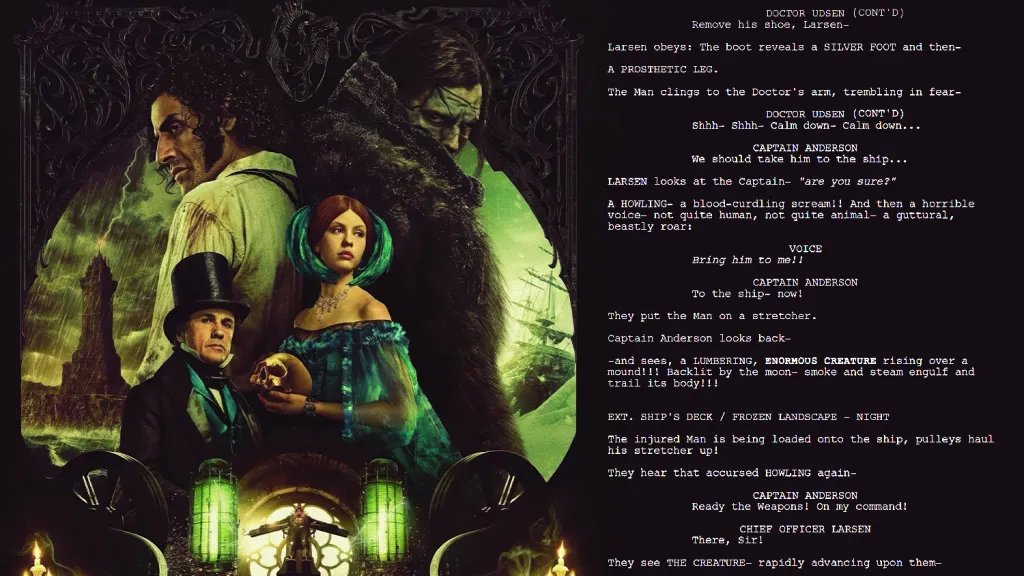
Read the screenplay below.