
Billie Eilish’s Unique Connection in James Cameron’s 3D Concert Documentary ‘Hit Me Hard and Soft’: Critics Share Their Thoughts
Billie Eilish’s World Tour: A Cinematic Experience with James Cameron
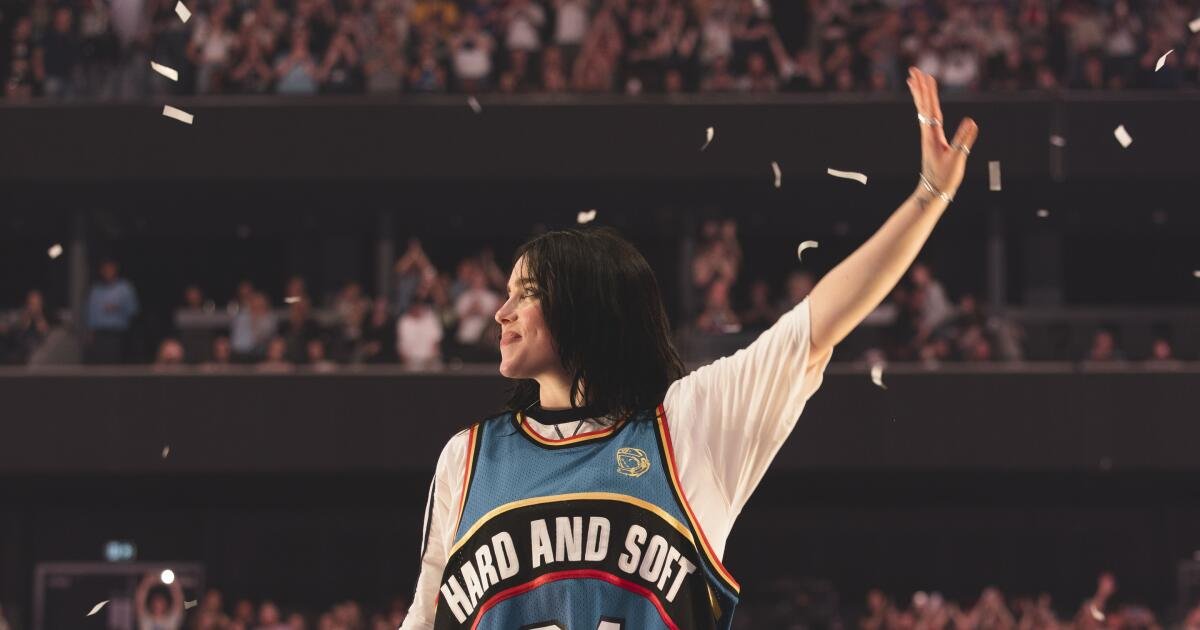
Billie Eilish’s "Hit Me Hard and Soft" tour achieved remarkable success, selling out all 106 shows across four continents and attracting over 1.5 million fans. For those who were unable to attend or wish to relive the experience, a concert film capturing four nights at Manchester’s Co-op Live Arena last July is now in theaters. Notably, the film features co-direction by acclaimed filmmaker James Cameron alongside Eilish.
Titled “Billie Eilish — Hit Me Hard and Soft: The Tour (Live in 3D),” this film offers an intimate glimpse into Eilish’s minimalist production, enhanced by Cameron’s advanced high-frame-rate technology, which was also utilized in his latest film, “Avatar: Fire and Ash.” The production’s simplicity focuses attention on Eilish’s performances rather than elaborate stage setups, with her backup singers notably not wearing matching shoes, underscoring the tour’s authentic vibe.
Pop music critic Mikael Wood and film critic Amy Nicholson engage in a discussion regarding the film’s impact and Eilish’s artistic connection with her audience.
Wood comments, "Like Kate Winslet’s well-to-do Rose and Leonardo DiCaprio’s impecunious Jack, the two of us come to ‘Hit Me Hard and Soft: The Tour’ from different perspectives." With Nicholson’s lack of concert experience contrasting his, he expresses curiosity about how the film shapes her understanding of Eilish’s artistry and the connection with her fans. He draws attention to Cameron’s presence in behind-the-scenes footage and the technical prowess displayed throughout the film.
Nicholson reflects on the emotional depth of the performance, noting her familiarity with Eilish’s music. She finds the film’s close-ups enhance the connection to the audience and Eilish’s lyrics, transforming the concert experience into an exploration of young people’s deeply rooted responses to music. “That rendition of ‘Your Power,’ in which Eilish seems to be channeling an entire generation’s anxieties? Chills,” she adds.
Throughout their exchange, the film’s nuanced portrayal of the audience during emotional moments—teens singing and crying—captures the profound impact of Eilish’s music.
Nicholson describes the unique qualities of the film, humorously stating, “I feel like I’ve been to a Billie Eilish concert more than if I’d actually been to a Billie Eilish concert.” She acknowledges that the 3D technology made the experience more immersive, allowing viewers to appreciate the emotional resonance and connection between Eilish and her fans.
Despite the film’s setting in Manchester, Nicholson humorously notes the absence of British accents in the crowd, speculating about the international appeal of Eilish’s music and concert pricing issues leading American fans to travel abroad for performances.
Wood proposes that while concert films have improved significantly, the tangible connection between artists and their audiences remains irreplaceable. He mentions the trend of artists designing live shows with both physical and digital audiences in mind, alluding to modern festival performances.
As their conversation draws to a close, they touch on Cameron’s long-standing celebration of female empowerment and Eilish’s commanding stage presence. Nicholson remarks on Eilish’s screen charisma and hints at her upcoming acting role, emphasizing a newfound interest in her artistic journey.
“This is her show,” Nicholson asserts, highlighting Eilish’s creative control while acknowledging the complexities behind credit in collaborative projects.
The discourse between Wood and Nicholson reveals a dynamic perspective on Eilish’s concert film, celebrating both her artistry and the emotional power that unites generations through music.