

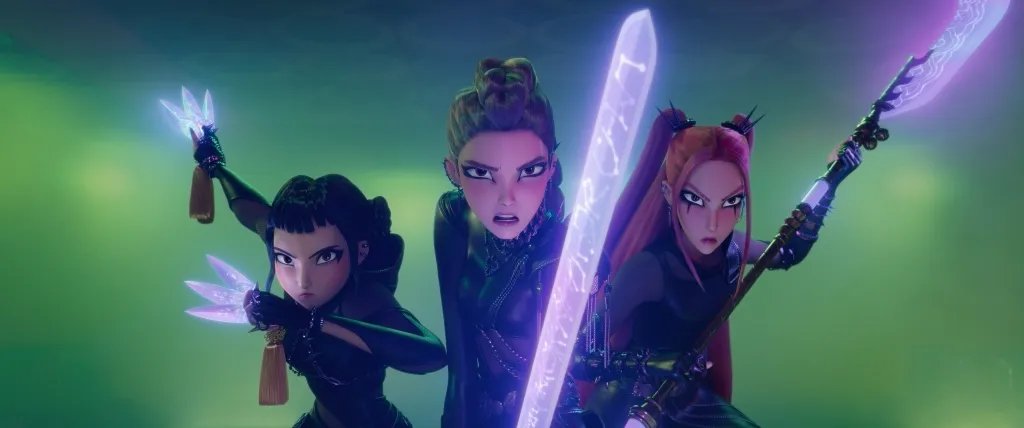
KPop Demon Hunters Songwriters EJAE and Mark Sonnenblick Share Insights on Crafting Romantic Tension, Haunting Melodies, and Their Unused Song
The enthusiastic response to Netflix and Sony Pictures Animation’s KPop Demon Hunters continues to soar. The film has achieved record-breaking streaming figures on Netflix and has dominated the Billboard charts, setting a promising tone as award season approaches.
Co-writer Mark Sonnenblick remarked, “All of this reception is inspiring. Behind this movie is a city of artists and executives who poured their hearts into something that may have seemed obvious, because it’s like, of course, K-pop is popular, but it wasn’t that simple. This was such a labor of love for something that isn’t big IP, and to see the response that the audience has had and the love of the fans, that’s the only reason why we’re even in these conversations, because of how people have built word of mouth and formed a relationship with the material. I have nothing but gratitude.”
KPop Demon Hunters has recently garnered music nominations for Best Original Song in a Motion Picture at the Golden Globes, Best Song at the Critics’ Choice Awards, and Best Compilation Soundtrack for Visual Media at the Grammys.
In a recent interview, the songwriting duo shared insights into their hit singles and the journey of their careers.
DEADLINE: What was the first song you both cracked together?
MARK SONNENBLICK: “How It’s Done.”
EJAE: I think it was “Your Idol,” because we were still working on the lyrics of “How It’s Done.” “Golden” was the last song we worked on.
DEADLINE: “Your Idol” has a really cool, haunting sound. Talk about the composition behind that track.
SONNENBLICK: It’s our spooky track. We ran it by Maggie [Kang, co-director] and Chris [Appelhans, co-director] to ask whether that vibe was the right energy for what they had in mind, since they already had some of the Saja Boys’ character designs in demon form at that point.
EJAE: The track had this dark choir sound sampling in it, so I stuck to that and laid down a bunch of melodies and freestyled, “I’m a be your idol.” That line was a lightbulb moment because I was a K-pop trainee for a very long time, so I’ve seen the dark side of K-pop, and the idea of idolizing someone can be very toxic. So, I added that creepy cathedral sound, the “Pray for me now” lyric. Mark started spitting bars that also worked as a double entendre, and we Frankenstein-ed the melodies together.
SONNENBLICK: This song is really where we cracked the workflow, too. EJAE with the melody and concept accomplished everything the directors wanted: this idea of toxic relationships with K-pop groups and their fans. It was a song to check this kind of religious demonic thing that they have going on. It’s also about checking the box for a toxic relationship with someone you potentially love, while trying to make it stand as a pop song.
EJAE: It’s a song about taking souls, and the added layer of HUNTR/X connects people through music, but the Saja Boys divide people through music.
DEADLINE: What was the most difficult song to craft?
EJAE: “How It’s Done.”
SONNENBLICK: For sure.
EJAE: We for sure did not know how it was done, done, done back then.
SONNENBLICK: It was particularly challenging because it’s the first song in the movie, so it’s got to make you lean in and introduce the characters and the vibe of the film.
EJAE: There was so much pressure because it’s the first impression.
DEADLINE: “Free” is a song that I can’t get enough of. It’s so cute. What was the composition of that song like?
SONNENBLICK: That song was the first time I had met Stephen Kirk and Jenna Andrews, and they had a draft of the verse and chorus, which has that beautiful melody. So, I started working with them on it, and with Maggie and Chris, I realized it was more than a traditional love song. We aimed to show two people becoming increasingly vulnerable toward each other while discovering they’re both cautious. They don’t have many good reasons to trust each other, but they’re finding that vulnerability is healing them. It rides a line of being more of a subtle love song than the big-throated romantic duets.
The process involved telling the story truthfully through the lyrics, shifting from “What if it feels right standing right in front of you?” — which implies strength — to “Why does it feel right every time I like you in?” This latter line captures a moment of uncertainty and vulnerability.
DEADLINE: I love that line in “Golden” that goes, “Called a problem child, because I got too wild, but now that’s how I’m getting paid.” I’m curious: when did you start taking yourselves seriously as artists?
SONNENBLICK: I’ve been fortunate to support myself as a songwriter. Although this wasn’t always the case, I’ve learned to roll with the punches, leading me to find opportunities and people who inspire me. I’ve taken on various jobs to support myself, but the encouragement of friends and family has been invaluable. I wouldn’t have considered writing songs in this way ten years ago. I’ve been in bands, written a musical, and the beauty of being an artist lies in being open to the journey.
EJAE: I aspired to be a K-pop idol, starting my training at age 11 and continuing for 12 years. Ultimately, I got dropped and was lost regarding my next steps. I embraced production and fell for the Soundcloud scene. However, the pressure to maintain a social media presence became overwhelming, especially since I am sensitive to criticism regarding my appearance. I realized prioritizing my mental health was essential, especially as I had friends in the industry who faced tragic outcomes. I chose differently, and I’m grateful to be here now as the singing voice behind an animated character.
SONNENBLICK: In one of the most-watched animations of all time.
DEADLINE: Is there anything left on the cutting-room floor that you wish you could have snuck into the movie?
EJAE: Absolutely, there are so many. There was one for Rumi, during the Celine moment right before “Your Idol.”
SONNENBLICK: It was amazing.
EJAE: Rumi has this breakdown and was supposed to have her moment, leading to a ballad that echoed a dark, moody vibe like 007’s “Skyfall.”
SONNENBLICK: Very Imogen Heap.
EJAE: We experimented with a combination of Korean pansori and arirang, blending traditional folk melodies with pop, which I wish audiences could hear.
SONNENBLICK: We never hear the full mantra, but EJAE created a line, “We are hunters, voices strong,” with beautiful harmonies.
EJAE: It included snippets of Rumi as a child saying that line.
SONNENBLICK: Maybe in the sequel.
EJAE: We’ll see.
[This interview has been edited for length and clarity]