The Inspiring True Stories of Revolutionaries Behind the Battles in the Movie
Leonardo DiCaprio as Bob Ferguson in ‘One Battle After Another.’
Credit:
Courtesy of Warner Bros. Pictures
Key Details from One Battle After Another
- Parts of One Battle After Another were adapted from Thomas Pynchon’s 1990 novel Vineland.
- Pynchon’s book was inspired by the Weather Underground, a revolutionary organization responsible for 25 bombings in the 1970s.
- Teyana Taylor cited Black Liberation Army member Assata Shakur as a reference for her portrayal of Perfidia.
The film One Battle After Another offers a fictional narrative that draws inspiration from real-life events and figures. The characters played by Leonardo DiCaprio, Regina Hall, and Teyana Taylor are loosely based on historical revolutionaries.
Premiering in September 2025, the political dramedy focuses on a group of once-idealistic revolutionaries who find their tranquil lives disrupted by a new threat, forcing them back into an underground existence they believed they had left behind. Director Paul Thomas Anderson disclosed in an August 2025 interview with Esquire that the screenplay had been in development for over two decades.
“Twenty years ago, I started writing this story, and the kernels of it were basically just to write an action car-chase movie,” said Anderson, referencing his adaptation of certain elements from Pynchon’s Vineland.
He elaborated, stating, “Vineland was always going to be too hard to adapt, so I stole the parts that spoke to me and just started running like a thief. I guess that’s what all us writers do — we’re thieves.”
Inspired by the radical movements of the late 1960s and 1970s, One Battle After Another explores social and political themes relevant to contemporary issues. DiCaprio remarked in a September 2025 interview with Radio Times that Anderson’s depiction of the “French 75” draws from the Weather Underground, while Taylor noted her character Perfidia was influenced by Shakur.
Is One Battle After Another Based on True Events?

Benicio Del Toro as Sensei St. Carlos in ‘One Battle After Another.’
Courtesy Warner Bros. Pictures
No, One Battle After Another is not based on a true story. Although it incorporates elements from Pynchon’s Vineland, the characters and revolutionary groups are loosely inspired by historical movements from the 1960s and 1970s.
Anderson has expressed interest in adapting Vineland but focused on a different story that featured a female revolutionary. “Sometimes I thought I would like to adapt Thomas Pynchon’s Vineland, a book written in the eighties about the sixties,” he told DiCaprio during their discussion. “But I was looking at it in the early 2000s, thinking of what the story means at that time. Cut to a whole other story that I had floating around that was about a female revolutionary.”
He commented on the lasting nature of the themes, stating, “Whatever seems to be happening politically seems to always be the same. Same s—, different year.”
Who Are the French 75 Based On?

Carl Laufer, a former member of the Weathermen, in 1981.
Denver Post via Getty
DiCaprio noted that the fictional French 75 militant group is based on real-life revolutionaries known as the Weather Underground, who opposed imperialism and civil rights violations during the Vietnam War. He described group members as culturally diverse individuals who were prepared to risk their lives for their beliefs.
The Weathermen originated as a splinter group from the Students for a Democratic Society (SDS) after the latter’s fragmentation in 1969. Their 1974 manifesto outlined their intent to “disrupt the empire … to incapacitate it, to put pressure on the cracks.” By 1975, the Weathermen had been linked to 25 bombings, including an attack on the U.S. Capitol. Although they aimed to minimize civilian casualties, three members lost their lives in a 1970 incident while constructing a bomb.
Is Perfidia Inspired by a Real Person?

Teyana Taylor as Perfidia in One Battle After Another; JoAnn Chesimard, aka Assata Shakur, on October 7, 1987 in Old Havana, Cuba.
Courtesy Warner Bros. Pictures; Ozier Muhammad/Newsday RM via Getty
While Anderson has not explicitly linked Perfidia to a specific historical figure, Teyana Taylor has cited Assata Shakur, a former Black Liberation Army member, as an influential reference for her portrayal.
In discussions with Radio Times, Taylor recounted discovering Shakur’s autobiography during early conversations with Anderson, which informed her character’s development. “I kind of feel like it was a full-circle moment,” she said, expressing excitement for the character’s direction.
Shakur became a key figure in the Black liberation movement of the 1970s. Convicted in 1977 on multiple charges including murder stemming from a 1973 shootout, she escaped prison in 1979 and fled to Cuba, where she was granted political asylum. Shakur passed away on September 25, 2025, just a day before the film’s premiere.
Taylor clarified in a November 2025 interview, “I don’t look at Perfidia and say, ‘This is Assata’s life.’ These are two women who were unapologetically themselves… they stood ten toes down on what they believed in. You can’t do anything but respect that.”
What Historical Events Inspired One Battle After Another?
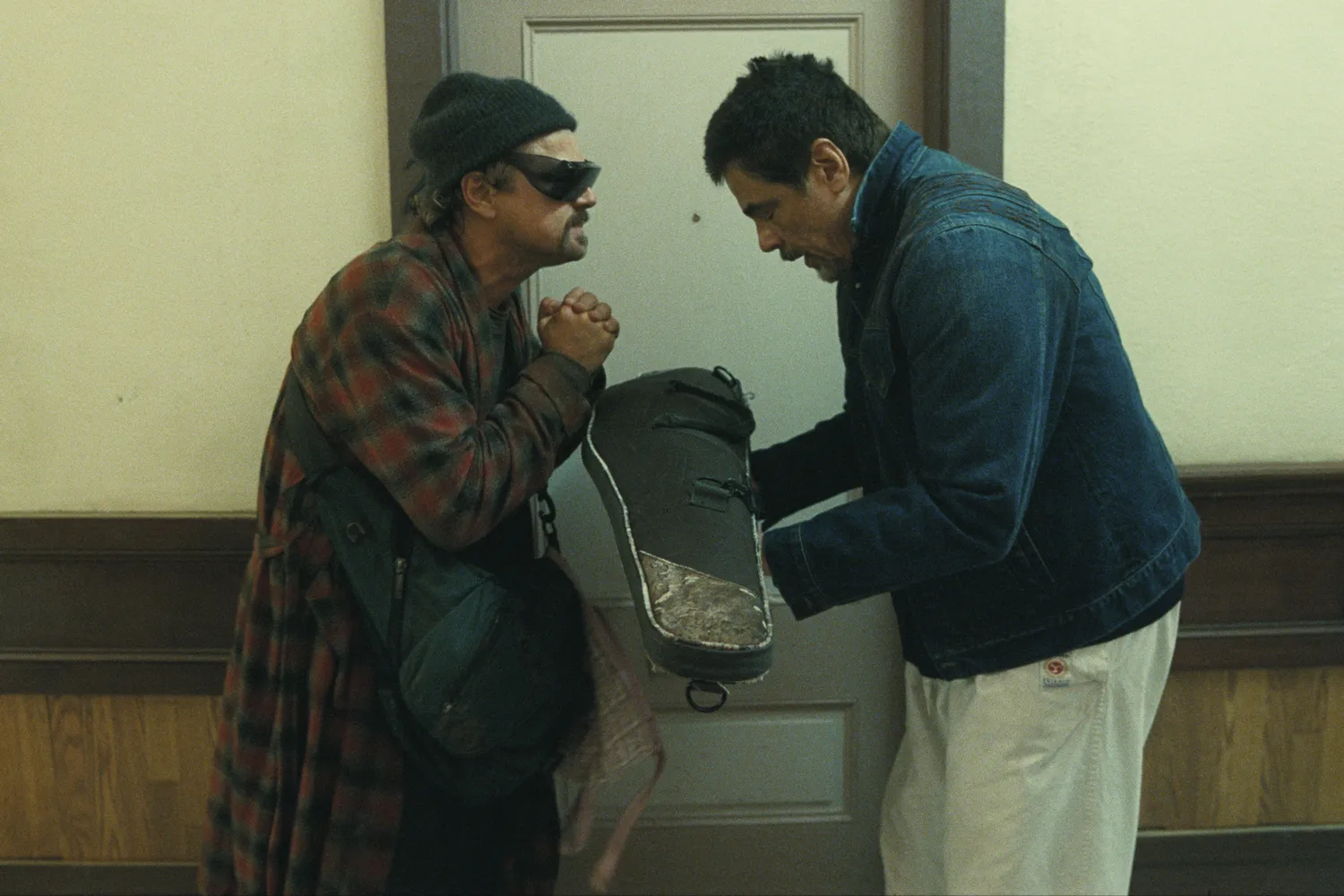
Leonardo DiCaprio as Bob Ferguson and Benicio Del Toro as Sensei St. Carlos in One Battle After Another.
Courtesy Warner Bros. Pictures
The elements of One Battle After Another— particularly those drawn from Vineland— reflect the activities of leftist revolutionary groups that were active in the 1960s and the subsequent societal reactions to their agendas. The film brings Pynchon’s narrative into a contemporary setting while preserving its exploration of countercultural movements against a backdrop of police violence, racial injustice, and governmental authority.
As Hall remarked, “Paul started writing this movie 20 years ago, so I don’t think that it was necessarily connected to the political relevancies of today. But boy does it coincide!”
Taylor shared that the film resonates strongly with current societal issues, posing a reflective question: “Why is this still relevant today? Why are we still going through this? And where is the change? … I definitely think that this movie will create a lot of healthy dialogue and much-needed conversations that need to be had.”