

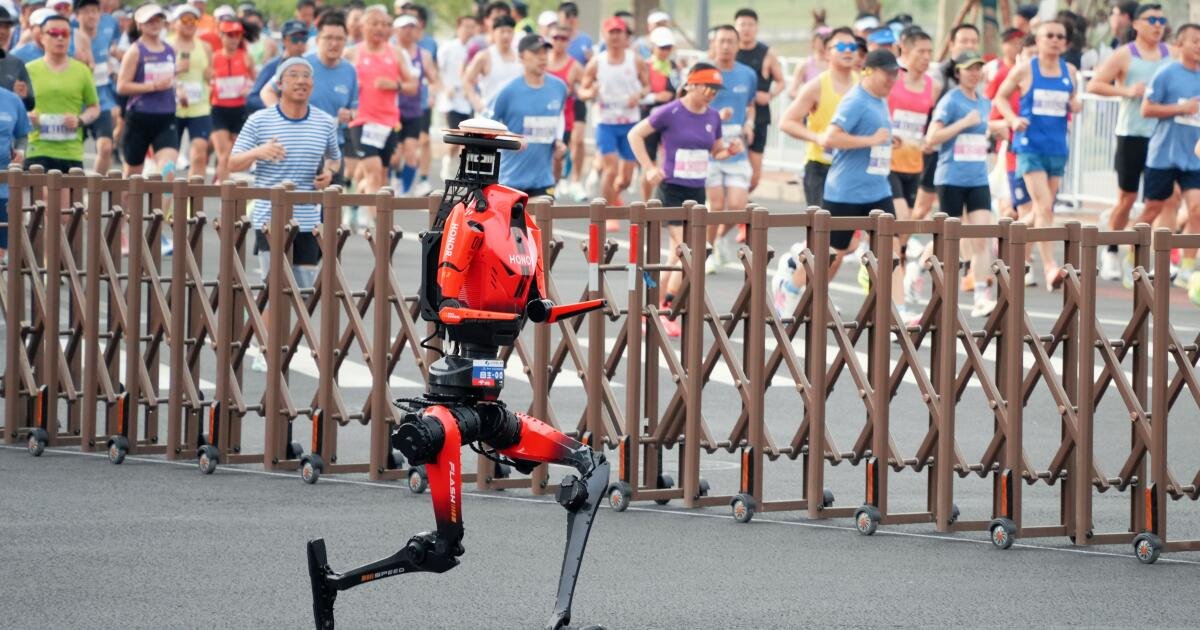
Robot Lightning Outruns Human Runners to Set Half-Marathon Record in Beijing
Robot Sets New Half-Marathon Record at Beijing Race
In a remarkable turn of events, the world record for the half-marathon was shattered in Beijing on Sunday by a humanoid robot named Lightning. The robot completed the 13.1-mile course in an astounding 50 minutes and 26 seconds, marking a significant achievement in the realm of robotics, outpacing the previous record set by Ugandan runner Jacob Kiplimo, who clocked in at 57 minutes and 20 seconds in Lisbon last month.
Lightning was among over 100 robots participating in the race held in the Beijing Economic-Technological Development Area, commonly known as Beijing E-Town. While many of its robotic counterparts faced crashes and collisions, Lightning displayed impressive resilience, managing to recover from a fall and continue its race to victory. This achievement is noteworthy not only for its time, which is nearly seven minutes quicker than Kiplimo’s record, but also for surpassing the performance of all 12,000 human runners in the event.
The robot, designed by the Chinese smartphone company Honor, highlights the exciting advancements in technology. Despite encountering a barricade during the race, Lightning was quickly assisted back to its feet and sped toward the finish line. Last year’s winner finished in a time of 2 hours, 40 minutes, and 42 seconds, making Lightning’s performance particularly striking.
This year’s event saw optimized rules allowing robots to compete using either autonomous navigation or remote control, with Lightning utilizing the former. New awards were introduced for Best Endurance, Best Gait, Best Design, and Best Perception, showcasing the diverse capabilities of the participants.
This year’s race stood in stark contrast to the inaugural Humanoid Robot Games held in Beijing last August, which involved nearly 300 teams from 16 nations in various competitions. Reports from that event noted considerable challenges for the robots, with many falling or colliding during matches. In contrast, this year’s race was hailed as a significant advancement in the robotics field, reflecting the ongoing transition from laboratory prototypes to practical applications.
Zhao Haijie, a human participant who finished with a commendable time of 1 hour, 7 minutes, and 47 seconds, remarked on the speed of the competing robots. "I felt it was going quite fast," Zhao said, recalling how Lightning zoomed past him in a blur.
Current standings in the global robotics race suggest that China is at the forefront, with more operational robots than the rest of the world combined. An analyst noted that at least 80 humanoid robot companies are actively operating in the country, a stark contrast to the five firms in the United States. This dominance raises questions about the implications of advancements like Lightning, particularly concerning future developments in robotics.
The innovative cooling system used in Lightning, adapted from Honor’s smartphones, is a practical application resulting from this technology-driven competition. As robotics continues to evolve, events like this set the stage for future breakthroughs, potentially transforming industries and everyday life.