
Reflecting on 50 Years of ‘Rocky’: Sylvester Stallone Talks Oscars and the Search for Hope
In 1976, Sylvester Stallone was on the verge of a career-defining moment. At that time, he was an actor with seven years of minor roles, struggling to make a name for himself in Hollywood. His breakthrough came with *Rocky*, a project he developed following a modest performance in the coming-of-age film *The Lords of Flatbush* (1974), where he contributed additional dialogue. Stallone’s journey to stardom began with the inspiration drawn from boxer Chuck Wepner, who famously went nearly 15 rounds with Muhammad Ali, leading Stallone to create the underdog story of Rocky Balboa.
Although United Artists appreciated the script, they were hesitant about Stallone’s insistence on playing the lead role, offering him a substantial sum to step aside. With only $106 to his name, Stallone chose to remain in the role, a decision that would ultimately reshape his career.
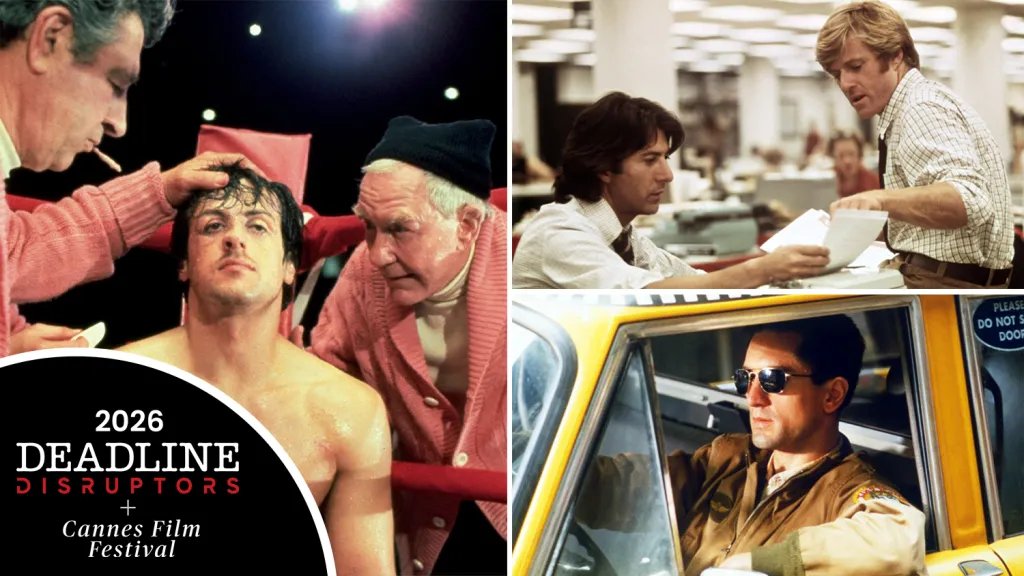
Sylvester Stallone as Rocky Balboa.
Reflecting on the Oscar night that transformed his life, Stallone sees it as a high point, rivaled only by his recent recognition at the Kennedy Center Honors. The night was a mix of disbelief and excitement for the screenwriter and star of the Best Picture-winning film, viewing it as just as surreal as his rise from a struggling actor to a global icon.
Stallone recalls facing unexpected verbal jabs, particularly from playwright Paddy Chayefsky, who was nominated for Best Screenplay for *Network*. Chayefsky bluntly stated, “Your screenplay is never going to win,” which left Stallone questioning the fairness of the competition. Chayefsky also predicted *Network* would take home Best Picture, a claim that hung heavy in the air until the final results were announced.
Despite Chayefsky’s jibes, Stallone received kind words from acting legends like Kirk Douglas and William Holden, who praised his work. Stallone found the experience overwhelming and felt he had reached an artistic peak. “The good news is, I’ve peaked — and the bad news is, I’ve peaked,” he mused.
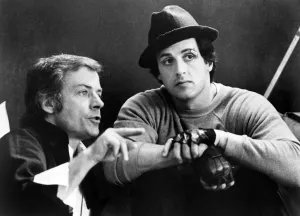
Director John G. Avildsen with Stallone on set for ‘Rocky.’
Stallone’s unique approach to storytelling, driven by personal experience rather than overt political messaging, resonated with audiences. He articulated the era’s shift toward narratives that were uplifting rather than dark, capturing the zeitgeist of a country in search of hope.
Despite numerous missed opportunities to hand over the *Rocky* role for a quicker payday, Stallone remained steadfast. The production, which was completed in just 24 days, leveraged innovative Steadicam technology to bring an unprecedented realism to the boxing scenes, elevating the film’s impact. With a box office total of $225 million, *Rocky* emerged as the highest-grossing film of 1976.
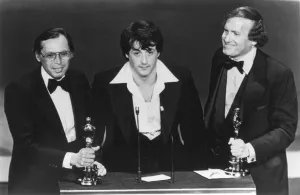
From left: Irwin Winkler, Stallone, and Robert Chartoff receive the Best Picture award for ‘Rocky.’
When Oscar night arrived, Stallone initially expected *Rocky* to finish as a runner-up, especially after losing several nominations. However, the mood shifted with John Avildsen’s win for Best Director, setting the stage for an unforgettable climax. When Jack Nicholson announced *Rocky* as the recipient of the coveted Best Picture award, Stallone was left speechless.
“When we won, I was so stunned,” Stallone recalled, “I just went, ‘Oh my god.’” As he took the stage alongside producers Irwin Winkler and Robert Chartoff, Stallone pondered the contrasting perceptions that might come with a “Tony Manero look” as he received the prestigious accolade.