
Oscars Embrace Political Moments: How Donald Trump’s Media Critique Sparks Responses from Presenters and Winners During Turbulent Times
The Oscars this year embraced a more political tone, reflecting the turmoil of recent times, both through the winners and the speeches delivered on stage. Honored films like One Battle After Another and Sinners underscored these themes, which resonated amid the backdrop of Donald Trump’s administration.
Opening the ceremony, host Conan O’Brien acknowledged the chaotic global landscape, stating, “If I can be serious for just a moment, everyone watching right now, around the world, is very aware that these are very chaotic, frightening times. It’s at moments like these that I believe that the Oscars are particularly resonant.”
He further remarked, “We pay tribute tonight, not just to film, but to the ideals of global artistry, collaboration, patience, resilience and that rarest of qualities today, optimism.”
A tradition of blending humor with social commentary has long been a hallmark of the Oscars, although the intensity of political statements has varied over the years. This year, presenters and awardees highlighted the diversity of nominees and the unique power of cinema to unite audiences.
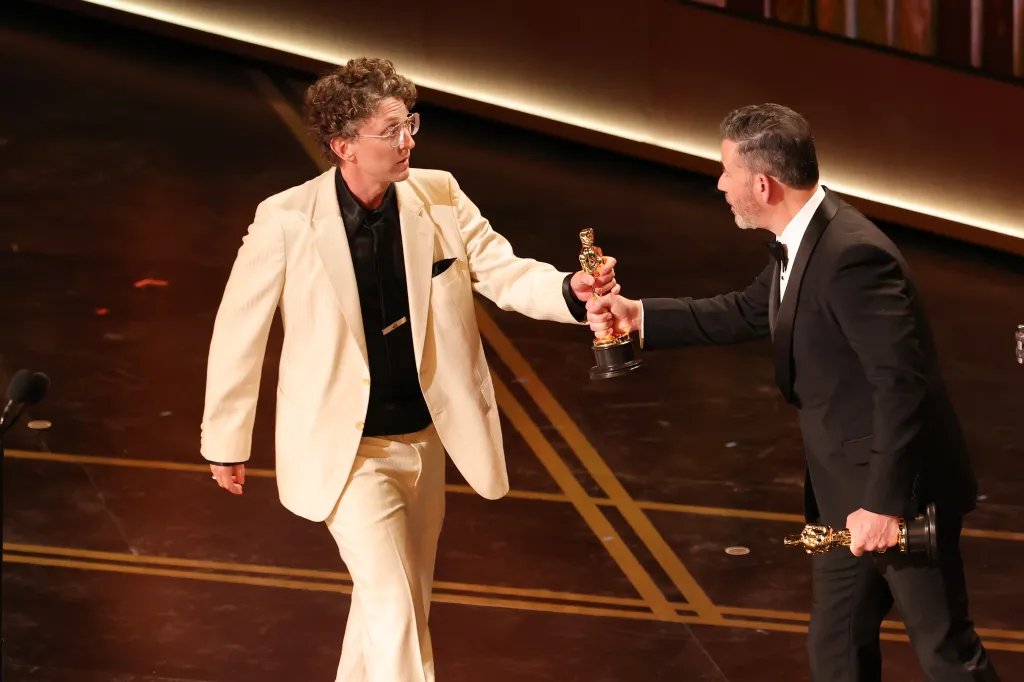
In a pivotal acceptance speech, Paul Thomas Anderson expressed hope for future generations, stating that they would “hopefully bring us some common sense and decency.” Meanwhile, Joachim Trier, honored for his international feature Sentimental Value, invoked James Baldwin, emphasizing, “all adults are responsible for all children, and let’s not vote for politicians who don’t take this seriously into account.”
Tributes to stars who passed away this year, including Rob Reiner and Robert Redford, also acknowledged their political influence, despite facing pushback for their activism.
Others took a more direct stance on current issues, addressing topics ranging from the situation in Gaza to free speech. Javier Bardem opened his presentation by proclaiming, “No to war, and free Palestine.”
Jimmy Kimmel, known for his candid critiques of Trump, delivered a playful jab at Melania Trump’s documentary, prompting a response from White House Communications Director Steven Cheung, who labeled Kimmel a “classless hack.”
While presenting the documentary awards, Kimmel stated, “We hear a lot about courage at shows like this, but telling a story that could get you killed for telling it is real courage.” He subtly referenced oppressive regimes, saying, “Let’s just leave it at North Korea and CBS.”
His comments gained added significance when he presented the Oscar for the documentary feature Mr. Nobody Against Putin, which focuses on a teacher’s confrontation with Russian propaganda amid the Ukraine invasion.
Co-director David Borenstein remarked, “This film is about how you lose your country… when a government murders people on the streets of our major cities, when we don’t say anything, when oligarchs take over the media… we all face a moral choice.”
Earlier in the evening, Trump criticized media coverage of the conflict in Iran on Truth Social, accusing it of being “corrupt and highly unpatriotic” and suggesting that news outlets could face treason charges for “dissemination of false information.” He praised his FCC chairman for threatening to revoke broadcasters’ licenses.
This incident seemed to echo the sentiments shared by O’Brien and other speakers at the Dolby Theatre regarding the relevance of AI in contemporary discourse. Trump claimed Iran was leveraging AI images as a “disinformation weapon,” highlighting the challenges of distinguishing reality from fabrication.
While Trump has not commented directly on the Oscars, the remarks from the ceremony may have only reinforced O’Brien’s assertion that, in these chaotic times, this year’s event was especially meaningful.