
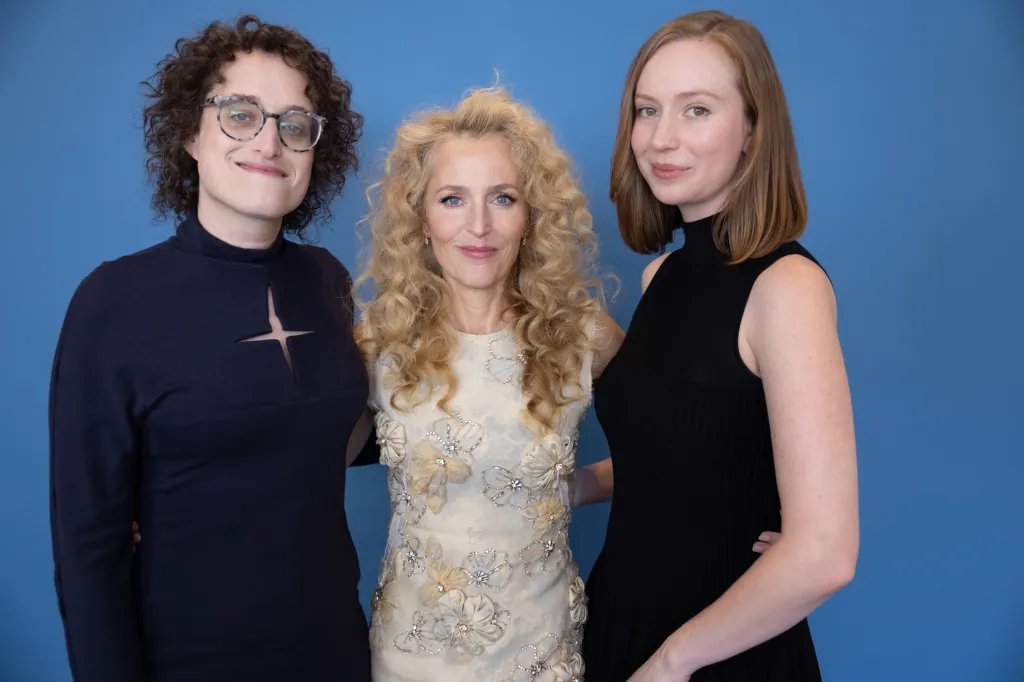
Hannah Einbinder Talks About Camp Miasma, Her Views on Palestine, and Collaborating with Jane Schoenbrun and Gillian Anderson at Cannes
Hannah Einbinder’s film, Teenage Sex and Death at Camp Miasma, opened the Un Certain Regard section at the Cannes Film Festival on Wednesday. On the same day, Einbinder participated in a Kering Women in Motion talk, where she expressed her commitment to speaking out alongside other Palestinian and Jewish allies. “I am really pleased to join a tradition of Palestinians and Jewish allies who are committed to being vocal in a time where a lot of people shy away from that. I follow their lead,” she stated. Addressing concerns about potential repercussions for her views, Einbinder mentioned, “I am under no impression that my one small career could ever measure up in comparison to even one human life.”
Watch on Deadline
Hannah Einbinder and Gillian Anderson in ‘Teenage Sex and Death At Camp Miasma’
Mubi
In the film, Einbinder plays a filmmaker who aims to revive a zombie slasher franchise by locating the original film’s now-reclusive ‘final girl,’ portrayed by Gillian Anderson.
Director Jane Schoenbrun indicated that the film draws from their personal experience of transitioning, stating, “It came from a moment in my life that was really exciting and fun, which was, you know, a year, a couple years into transition. For the first time, I was, I think, experiencing what a lot of people experience when they’re actually teenagers, which is like a puberty that feels right. I was coming into my body. I was coming into my identity, my confidence, my power and my sexuality, for the first time.”
Schoenbrun further explained that the film provided a means to process emotions surrounding trauma and dysphoria. “There was also getting over a lot of trauma and shame and imposter syndrome and dysphoria. And the perfect way to talk about that in a movie was through the slasher genre, because what other genre is so awash with gender anxiety, and these depictions of these trans sexual monsters, from Norman Bates to Buffalo Bill and everything in between, who are both like these objects of desire, but also these monsters? I wanted to truly remake the iconography around those films into something that felt authentic to what I was going through,” Schoenbrun said.
Anderson revealed that she had seen Schoenbrun’s previous work, I Saw the TV Glow, which helped her understand the new screenplay. “The script made sense to me in light of TV Glow. I’m not sure I would have immediately understood it, had I not had the experience of watching that film, but I felt like I understood it on so many levels,” she remarked.
She emphasized the film’s exploration of feelings of alienation, describing it as “a gift of understanding and compassion.” Adding that “anyone who has ever felt that they are on the outside of humanity or misunderstood — that’s a large proportion of humans on Earth, no matter what that separation is, it is really identifiable,” Anderson noted, “It’s also, incredibly moving and I cannot wait for people to see it.”
For further insights, the complete conversation can be viewed in the video above.