

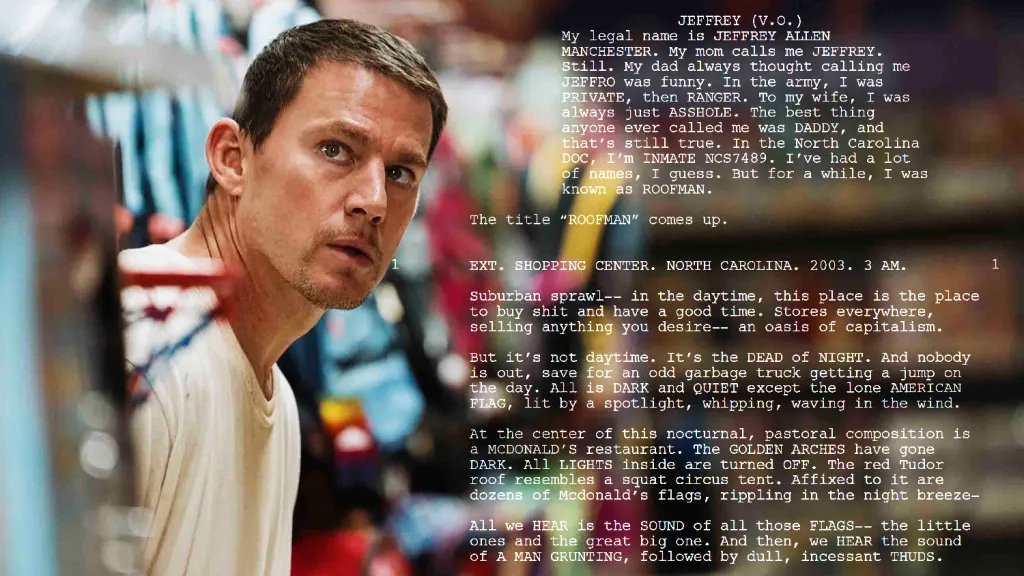
Explore the Screenplay of ‘Roofman’: A Thoughtful Look at a Criminal’s Journey Toward Redemption
Title: Blurring the Lines in "Roofman": A Complex Character Study
The film "Roofman," which premiered in the U.S. on October 10, offers a unique blend of genres, merging elements of crime, romance, and comedy. At its core, the narrative centers on a protagonist far more intricate than the typical antagonist.
Having grossed $33.6 million worldwide since its release, "Roofman" dives deep into the troubled life of Jeffrey, portrayed as a man teetering on the edge. The script, co-written by Derek Cianfrance and Kirt Gunn, introduces viewers to Jeffrey, an Army veteran from the 82nd Airborne Division. After returning from the Middle East in the late 1990s, he struggles to adapt to civilian life, facing rejection from his wife and losing his ability to provide for their three children. This desperation pushes him into a life of crime, revealing the profound emotional drive behind his actions.
Earned the nickname "Roofman," Jeffrey employs his intelligence and keen observational skills to orchestrate break-ins at fast-food restaurants, exploiting vulnerabilities in their architecture by cutting holes in roofs.
However, the narrative goes beyond the crime itself, painting Jeffrey as a dual character. Described by acquaintances as “brilliant” and a “mastermind,” he navigates both the physical and psychological landscapes to exploit weaknesses. Cianfrance acknowledges Jeffrey’s complexity, highlighting his “liar” and “con man” tendencies alongside the “big, broad mistakes that hurt people he loves.” Through a lens of empathy, the filmmaker captures Jeffrey as a “complicated, flawed, lovable quirky person.”
The story takes a turn after a dramatic prison break in 2004 when Jeffrey establishes a secret hideout within a Toys “R” Us for six months. This absurdity serves as a humorous juxtaposition to the film’s more tragic elements. A pivotal moment occurs when Jeffrey seeks human connection, ultimately leading him to a church and to Leigh, a divorced mother portrayed by Kirsten Dunst. Their relationship triggers a tense game of cat-and-mouse as Jeffrey’s secret life begins to unravel.
Cianfrance’s character-driven storytelling is evident in the film’s exploration of major themes, including optimism, redemption, and forgiveness. Producer Jamie Patricof emphasizes that "Roofman" acknowledges the repercussions of one’s actions, a sentiment echoed by Jeffrey himself, who expresses deep regrets for the pain he has caused and acknowledges his place in prison.
Cianfrance, inspired by a conversation with real-life Pastor Ron Smith, committed to portraying Jeffrey’s story “with grace as opposed to judgment.” By focusing on the emotional undercurrents of his life and his profound need for connection, "Roofman" presents a narrative that is outrageous yet profoundly relatable, capturing the essence of human vulnerability.