

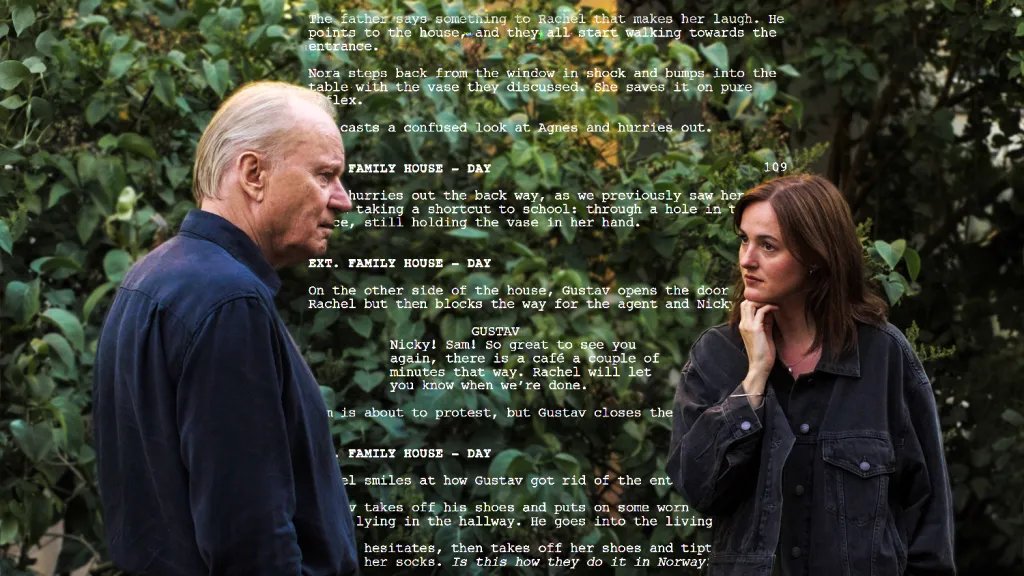
Explore the Screenplay of Joachim Trier’s Cannes Film About Artists, Family, and Healing
The film has garnered significant acclaim, winning the prestigious Grand Prix award at Cannes. It serves as Norway’s official submission for the International Feature Film category at the Oscars and is emerging as a strong contender across several major award categories this season. This includes eight nominations at the Golden Globes, featuring nods for Best Picture – Drama and acting awards for Reinsve, Skarsgård, Lilleaas, and Fanning. Additionally, it received seven nominations at the Critics Choice Awards, including Best Picture, with both organizations recognizing the original screenplay, which, notably, is ineligible for WGA Awards consideration.
The film also earned a leading eight nominations at the European Film Awards and made it onto the Oscars shortlist in the Cinematography, Casting, and International Feature Film categories.
Watch on Deadline
The narrative opens with the Borg family’s ancestral home depicted as a character in its own right—a living entity that encapsulates the family’s history, particularly that of the two adult sisters, Nora (Reinsve) and Agnes (Lilleaas), alongside the departure of their father. This introduction immediately establishes the home, symbolically representing a “crack in the family,” as the central emotional battleground.
The drama intensifies following the wake of the sisters’ mother, marked by the unexpected return of their estranged father, Gustav (Skarsgård), an acclaimed but aging director.
However, Gustav’s reappearance lacks genuine contrition. Instead, he presents a transactional offer: the lead role in his upcoming film, which he intends to shoot at the family home. Nora, an actress grappling with severe stage fright, is simmering with resentment over her father’s abandonment. She vehemently declines the role and storms off after a heated altercation.
Tensions quickly escalate as Gustav, whose relationships are shaped by his artistic endeavors, connects with rising American star Rachel Kemp (Fanning) in France. He offers her Nora’s part, prompting an emotional shock in Nora when she discovers Rachel’s presence at the house—reinforcing her worst fears that her father regards his family primarily as sources of artistic inspiration.
The screenplay skillfully employs a film-within-a-film narrative, based on the traumatic life and suicide of Gustav’s mother, as a means for unspoken communication between father and daughter. As Rachel prepares for her role, she realizes that the character relates not only to the grandmother but also mirrors Nora’s own struggles. The script becomes Gustav’s desperate avenue to express the inherited trauma he cannot articulate verbally.
The emotional core becomes evident when Nora reads the rejected script aloud to Agnes. The poignant line, “I want a home,” sparks a profound and tearful breakthrough. The sisters’ bond, forged through their shared experience of a “broken home,” emerges as a powerful source of healing, transcending their father’s manipulative artistry.
The screenplay, co-written by Trier and Vogt, is being lauded for its authentic portrayal of how conflicted artists navigate personal trauma through their work, even as they inadvertently inflict pain on those closest to them. This film stands as a profound exploration of love, art, and the painful legacies families leave behind.
Read the screenplay below.