
Celebrating Timeless Designs: The Best World Cup Jerseys from 30 Years Ago
Over the next few days, Spanish soccer will showcase a unique initiative as nearly 40 professional clubs in La Liga’s top two divisions don retro-inspired uniforms that reflect their own histories. These kits were unveiled at Madrid Fashion Week and are part of a campaign celebrating the nation’s passion for the sport, marking an intriguing lead-up to a significant upcoming event.
In just ten weeks, the largest World Cup in history will kick off across the United States, Canada, and Mexico. With 48 teams and 104 matches, this event promises to be the most extensive commercial platform ever created for the sport. Many players will sport nostalgic gear, as Adidas recently released new away kits featuring a “90s aesthetic” reimagined in a contemporary style. Notably, these kits will also showcase the brand’s iconic trefoil logo for the first time in over three decades.
This embrace of nostalgia extends beyond mere collection; it is evident in how past gear is being worn and reimagined today.
### The Shirts That Changed Everything
To grasp the evolution of soccer kits, one must trace their history back further than anticipated. “Proper fan replica shirts weren’t widely available until the 1970s,” noted Alex Ireland, author of “Pretty Poly: The History of the Football Shirt.” “It was really only in the nineties that they became more socially acceptable for outings.”
The significant shift in shirt culture can be attributed to Umbro’s England away shirt for Euro 96, designed to be worn casually. This innovative two-tone blue striped shirt was created to complement jeans, marking an early recognition of its utility beyond the pitch. Advancements in fabric technology further facilitated this transformation, allowing designers to create complex graphics directly on materials, which resulted in one of the most visually striking decades in soccer fashion.
“Everyone remembers their first World Cup,” said Sam Handy, General Manager of Football at Adidas. “Those kits get embedded in your memory — this is what football looks like.”
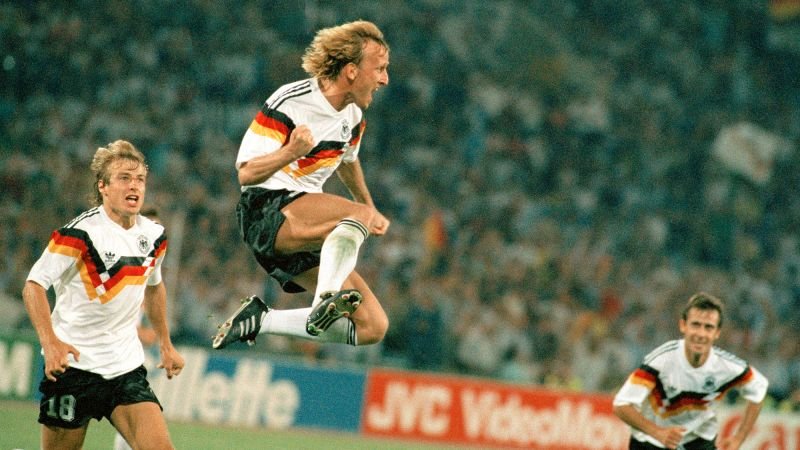
For many, that first World Cup was Italia 90, characterized by the West Germany home shirt — a bold black, red, and gold geometric design that is now a highly sought-after collectible. Norwegian collector Even Nesset recalled, “That shirt gives me a kind of false memory of 1990,” highlighting how these iconic shirts can evoke emotions tied to memories not lived firsthand. England’s third shirt from the same tournament, known for its sky blue color and distinct geometric patterns, has a price tag of $480 on various collector platforms.
While England did not wear this shirt in matches, its popularity and the team’s notable semi-final performance contributed to its legacy alongside the more traditional white home kit.
England’s Paul Gascoigne (right) in the classic home shirt, takes on West German’s Lothar Matthaus during the semi-final on July 4, 1990 in Turin, Italy.
As Handy noted, “When a brand takes risks in design and embeds it with a decent run for the team, you have a chance of creating something very visually sticky.” This strategy has created a dichotomy in shirt design, with some, like the bold USA 1994 and Jamaica 1998 kits being seen as “crazy,” and others, such as the Colombia 1990 and Italy 1994 shirts, classified as “beautiful” for their understated appeal.
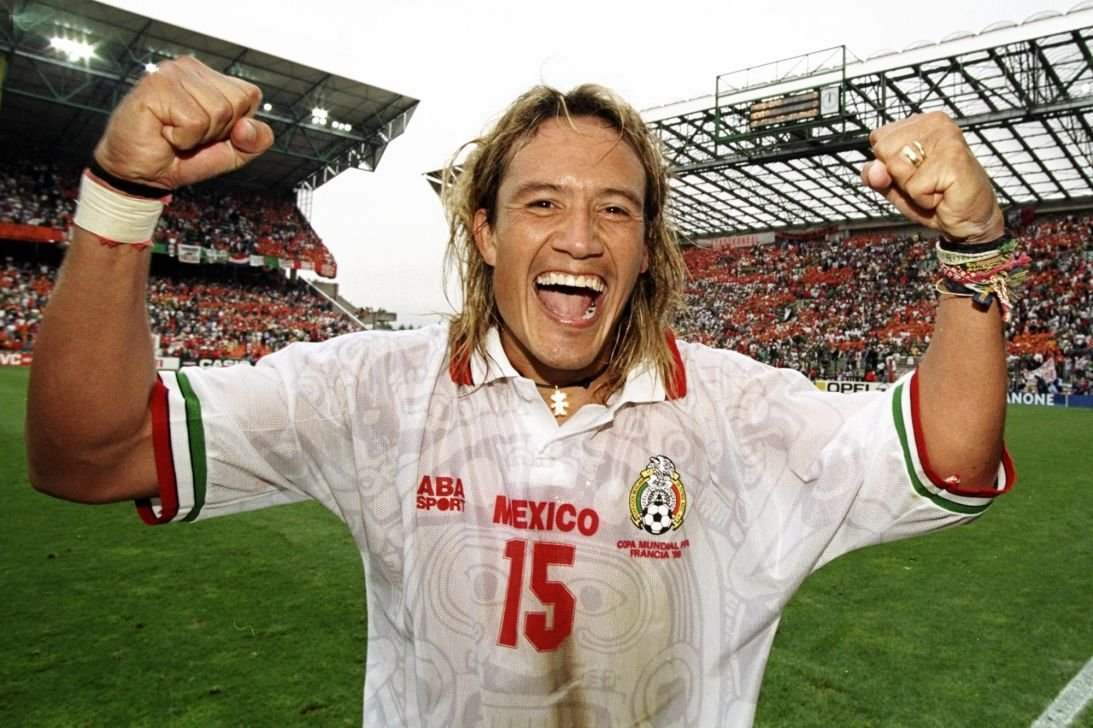
Luis Hernandez of Mexico celebrates after scoring the equalizer in a game against Holland during the World Cup in June 1998. Handy describes it as a “crazy” shirt.
Traditionally traded through flea markets and early online platforms, the market for vintage soccer shirts has undergone a transformation over the past two decades with the emergence of dedicated sites like Classic Football Shirts and Cult Kits. Founded by fans eager to find the shirts they loved, these platforms have evolved from passion projects into successful businesses.
David Jones, co-founder of Cult Kits, described a significant shift among buyers, stating, “Seventy percent buy for nostalgia — the players you pretended to be growing up. The rest have discovered soccer kits as a fashion statement.”
Stars such as Dua Lipa in a Brazil jersey and Timothée Chalamet in a striking green Mexico 94 shirt have notably worn vintage kits, turning them into fashion statements. Jones remarked on Chalamet’s choice, “because he genuinely does love football, so it lands differently,” a sentiment echoed for Dua Lipa, an avid Arsenal supporter.

Dua Lipa attends a football match in Rio in November 2025.
This cultural shift runs deeper than mere trends. Psychologist Clay Routledge has identified “historical nostalgia,” a yearning for eras one did not live through. His research indicates that 68% of Gen Z adults feel this way, suggesting a desire to resolve present discontent by connecting with something perceived as more authentic. Ireland points out that this phenomenon extends beyond football shirts to various elements of culture, linking it to the nostalgic appeal of reboots and the familiarity of past popular trends.
Cultural critic Simon Reynolds describes this condition as “Retromania,” where contemporary culture coexist with historical references, allowing younger generations to experience and connect with eras they never witnessed, like the World Cup of 1998.
### The Summer Everything Arrives at Once
“This is a defining era of soccer culture,” Handy emphasized, “and the jersey is perhaps its clearest expression.” The trefoil design, recently featured on a World Cup shirt for the first time since 1990, has appeared on special edition kits and is now included in 25 World Cup away kits. “We’re just trying to do it all — the past and the future — and letting it all exist at the same time,” Handy added.

The trefoil motif returns on 25 World Cup away kits.

Adidas recently unveiled new away kits embracing a “90s aesthetic” but designed in a “modern, contemporary way.”
Mat Davis, founder of Saturdays Football, has witnessed the evolution of the vintage market firsthand. As the market commodified, with an emphasis on price rather than uniqueness, he shifted focus to original products. Most recently, he partnered with Adidas to embroider mini versions of newly released away shirts onto Saturdays Football’s signature caps, blending amplification of brand identity with authenticity.
This phenomenon is vividly exemplified by the Adidas-designed US men’s national team (USMNT) shirt from the 1994 World Cup. Initially received with skepticism, this now-iconic shirt featured a unique washed-denim effect and diagonal white stars. Despite uncertainty, all 50,000 replicas sold out. Its legacy was cemented as the team made an unexpected run to the round of 16 in the jersey during critical moments of the tournament. Now, over three decades later, it serves as the inspiration for a new lifestyle collection that includes jerseys, jackets, and even shoes.

Adidas’ new lifestyle collection includes the classic 1994 shirt, which fans were pictured to be wearing at an international friendly match against Portugal on March 31, 2026 in Atlanta, Georgia.
Nike, who has outfitted the US team since 1995, is launching its 2026 kits in close partnership with players—an unprecedented move that will see all 27 US Soccer teams, including men’s, women’s, and youth teams, unified under a single visual identity for the first time. The design features bold red and white stripes that evoke a visual language similar to the iconic Adidas 1994 shirt.
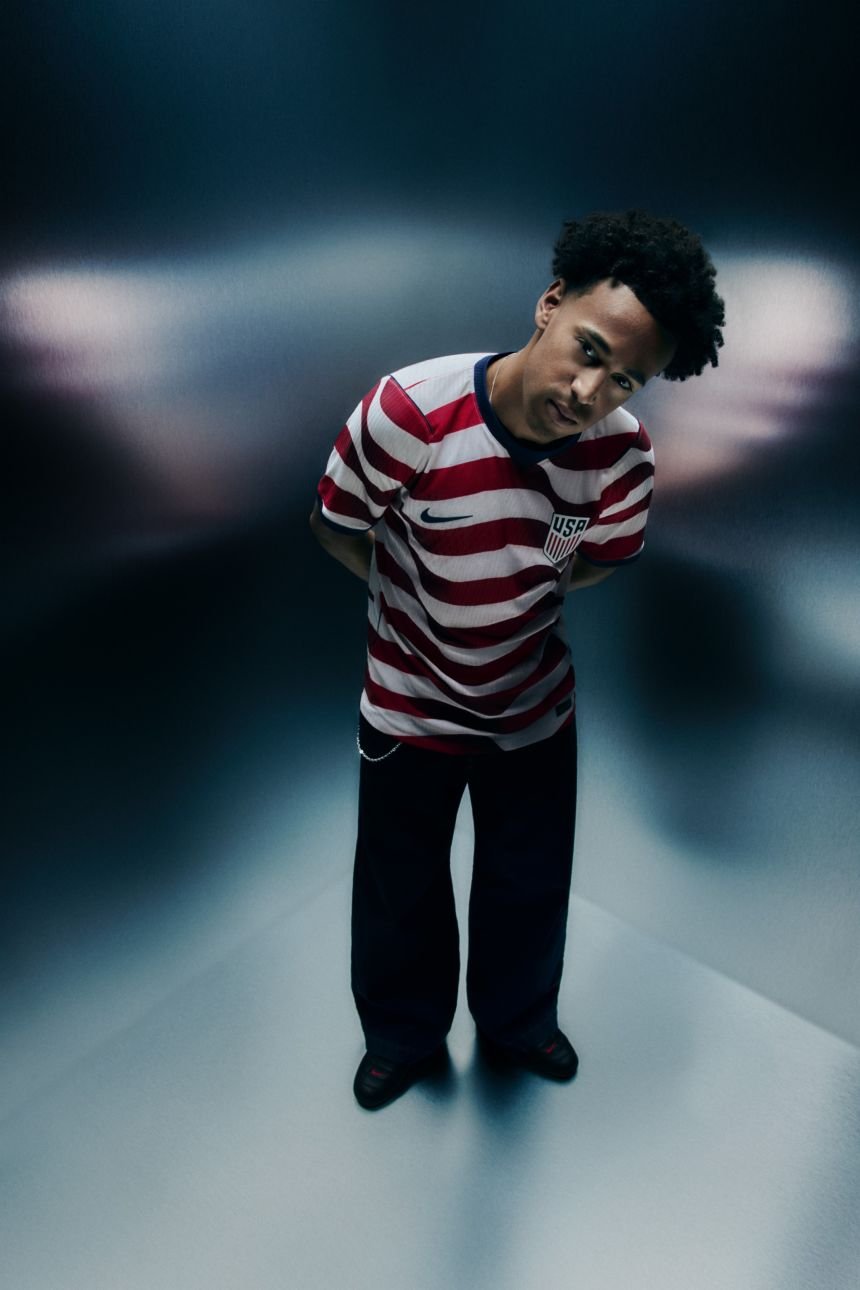
The Nike kit plays on stars and stripes, with these lines designed to appear in motion.
Handy posits that rather than relying on legacy, design will continue to evolve in an infinite cycle, with iconic styles becoming part of an ever-expanding visual canon.
This summer marks a pivotal moment in American soccer culture. Founded in 1993 as part of the effort to host the first World Cup, Major League Soccer has since grown to become a vital player in the sports landscape, reportedly surpassing baseball in popularity, as indicated by a recent survey from The Economist. With the World Cup returning to a nation that has deeply integrated the sport into its culture, memories of the past now permeate the current soccer experience.
USMNT midfielder Tyler Adams summarized the stakes succinctly: “I want to have that kit you look back at in 30 years and you’re like, that’s still the best one.” This summer, fans can anticipate seeing both vintage and updated designs in the crowd, each telling a story that bridges generations.
Inside the collar of Belgium’s Adidas away shirt, a subtle inscription reads: “Ceci n’est pas un maillot.” This is not just a jersey anymore.