
Why This Forward-Thinking Record Executive Still Supports Major Labels
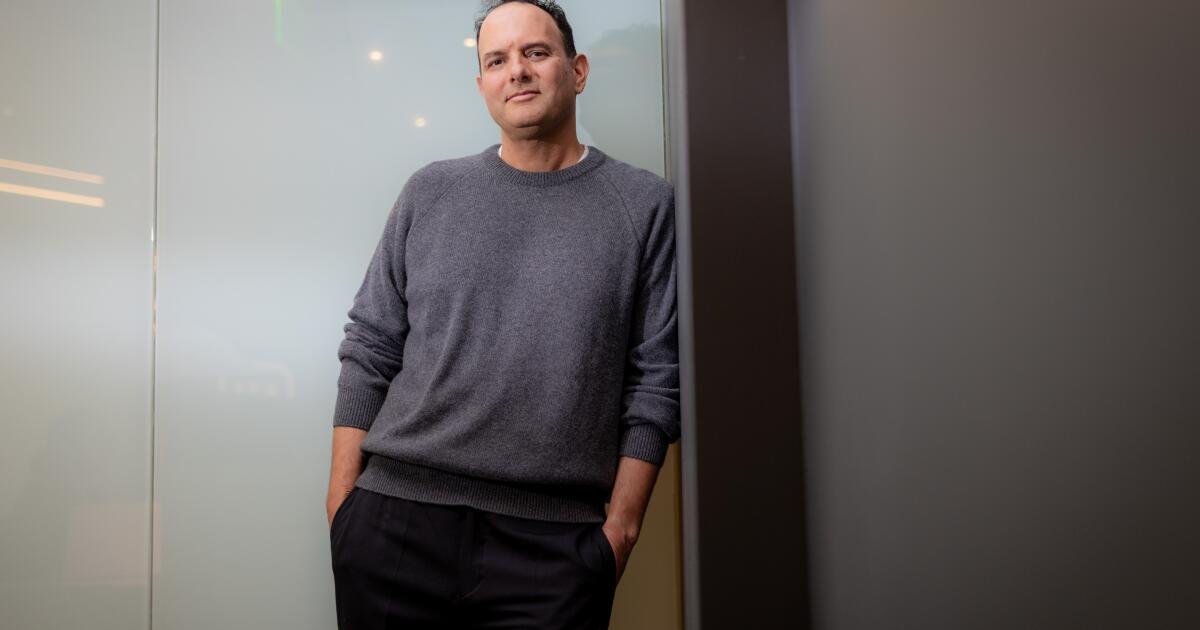
John Janick, chairman and CEO of Interscope Capitol, was spotted backstage at Inglewood’s YouTube Theater during a recent performance by the K-pop girl group Katseye. Dressed casually in jeans and a T-shirt, the 47-year-old watched as North West, the daughter of Kim Kardashian and Kanye West, made a quick entrance, bringing a buzz of excitement as she posed for photos with the six band members after their show. This encounter served as an important promotional opportunity for Katseye, whose fanbase thrives on social media engagement.
When Janick stepped forward to meet the group, they turned their full attention to him, a testament to his significant role in their rise to fame. He shares credit for assembling the group with Bang Si-Hyuk of Hybe, as highlighted in a Netflix docuseries. Together, they have propelled Katseye to success, achieving over 2 billion Spotify streams across their hit singles.
This weekend, Katseye will vie for the esteemed Best New Artist award at the 68th Grammy Awards. This acknowledgment marks a significant milestone for an act with roots in reality television, a background traditionally viewed with skepticism by the Recording Academy. “The dance break at the end of ‘Gnarly’ is gonna be so amazing at the Grammys,” Janick remarked to the group, igniting a wave of enthusiasm among the artists, who just three years ago were largely unknown.
Katseye’s nomination is part of a larger roster of accolades for Interscope Capitol, which also includes nominations for Album of the Year for Lady Gaga’s “Mayhem” and Kendrick Lamar’s “GNX.” Additionally, notable nods for Record and Song of the Year feature tracks from Gaga, Lamar and SZA, Billie Eilish, and Doechii. In total, Interscope Capitol secured 13 nominations across the top four categories this year—more than any other major label.
Despite his understated demeanor, Janick’s leadership has solidified his company’s standing in the music industry, which ended 2025 with a recorded music market share of 15.7%, according to trade journal Hits. Veteran record producer Jimmy Iovine, who co-founded Interscope, praised Janick, stating, “John’s a better executive than me by a f— mile.” Lucian Grainge, chairman and CEO of Universal Music Group, echoed this sentiment, emphasizing Janick’s impact on the company’s culture and success.
However, Janick’s achievements come at a time when the traditional major label model faces challenges. The rise of social media and digital streaming has made it increasingly viable for independent artists to reach broad audiences without the support of major labels. Bad Bunny’s “Debí Tirar Más Fotos,” recorded with the independent Rimas Entertainment, exemplifies this shift as it competes for Album of the Year.
The emergence of artificial intelligence is another factor that could reshape the music landscape. Janick acknowledges the necessity of adapting to these technological advancements. “I don’t think artists need major labels in 2026. It depends on what an artist wants,” he stated, highlighting the evolving nature of the industry.
In his spacious office at Universal Music Group, Janick depicted his vision for artist development in the current music scene. He emphasized a desire to elevate artists’ careers rather than merely profiting from their successes. “I want to help them achieve at a higher level,” he explained.
Janick stressed that Interscope provides access to invaluable resources and connections, facilitating ambitious projects, such as Billie Eilish’s upcoming 3D concert film. He refers to this concept as Interscope’s “flywheel,” drawing inspiration from Jim Collins’ business philosophy outlined in “Good to Great.” “IP is at the center, and then they can go execute across all the verticals,” he elaborated.
His approach resonates with established artists, including Lady Gaga, who described him as “an incredibly talented visionary,” praising his commitment to fostering a supportive environment for their music. Michael Polansky, Gaga’s fiancé and collaborator, reiterated that Janick leads with trust and respect, which is crucial in the creative industry.
In addition to nurturing prominent artists, Janick is dedicated to discovering “the next round of superstars.” Rising talents like Leon Thomas, Gracie Abrams, Role Model, and Sienna Spiro are part of Interscope’s growing roster. Janick’s involvement extends beyond boardroom decisions, with a hands-on approach that reflects a personal commitment to signed artists. He noted, “I feel a personal responsibility to anyone we’ve signed.”
His deep investment in artist development can be traced back to his early days in the industry. Janick founded the indie label Fueled By Ramen during his university years, leveraging early digital platforms to elevate bands like Fall Out Boy and Paramore. He later revitalized Warner’s Elektra Records, contributing to Bruno Mars’s ascent.
Despite emerging from a rock background, Janick has seamlessly adapted to lead a label historically associated with hip-hop giants. Joie Manda, a former associate, noted that genre boundaries have blurred under Janick’s leadership, allowing diverse talent to thrive. Today, Interscope Capitol includes a robust roster of Latin music stars and an updated roots music label, Lost Highway.
While some perceive Janick as overly controlling, others, including associates like Anthony Tiffith, refute this view, emphasizing his trust in their capabilities and projects. Janick’s recent focus on the success of Doechii, a Capitol artist who won the Grammy for Best Rap Album with “Alligator Bites Never Heal,” reflects his strategy of fostering slow and steady artist growth.
The rapid advancement of AI technologies prompts ongoing discussions within the industry regarding the future of music production and artist development. Janick expressed concern over ensuring artists are compensated for their work within this evolving framework, noting his explorations of AI capabilities with platforms like Udio.
As AI becomes an increasingly pressing issue, Janick’s focus remains on the artists and the development of future leaders within Interscope Capitol. While he contemplates his succession within the company, he is committed to cultivating talent and fostering a positive environment for his team. “I like working for Lucian,” Janick concluded, emphasizing his dedication to his role amidst the dynamic landscape of the music industry.