Filmmakers Discuss Creating a Relatable Human Story in Their Absurdist Dramedy “Two People Exchanging Saliva”
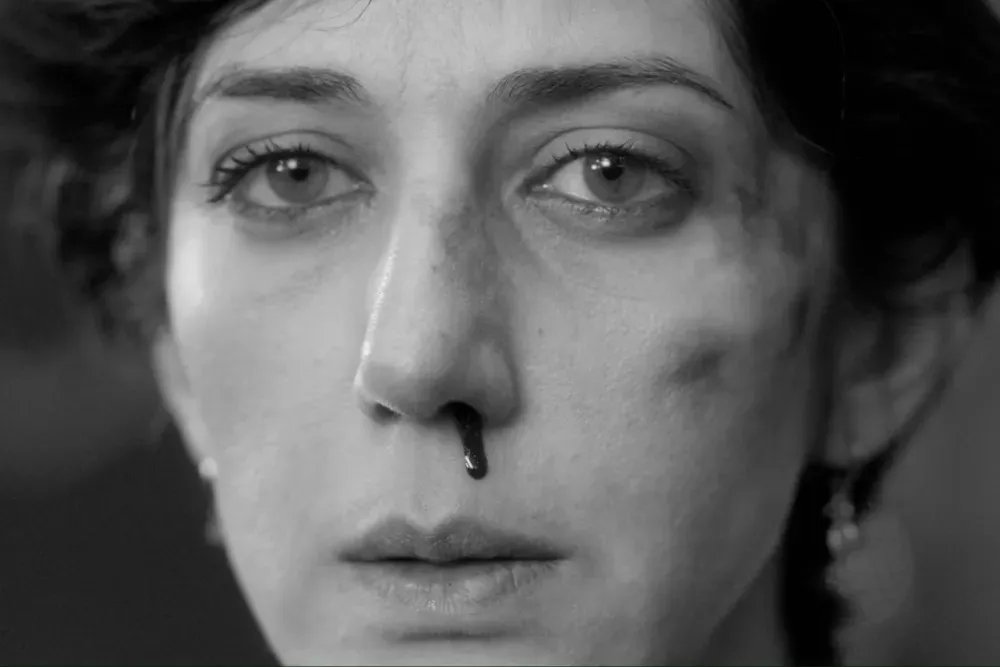
In a stark black-and-white universe, every kiss serves as a pathway to capital punishment in the short film Two People Exchanging Saliva, crafted by writer-director duo Alexandre Singh and Natalie Musteata. This dystopian queer love story unfolds in a reality where people pay for goods with slaps to the face, and kissing could lead to a fatal outcome. The narrative follows Angine (Zar Amir), a wealthy yet discontented individual drawn to a luxury department store. During her frequent visits, she develops a fascination for Malaise (Luàna Bajrami), a charming shopgirl. Their budding romance must remain clandestine, especially from Malaise’s watchful colleague.
The 36-minute short has garnered several accolades at various film festivals, including AFI’s Grand Jury Prize, the Golden Gate Mid-Length Film Award from the San Francisco Film Festival, and Best Drama Short from Out on Film in Atlanta. It also received both the Canal+ and audience awards at the Clermont-Ferrand Short Film Festival.
Watch on Deadline
DEADLINE: What inspired the concept of kissing as a crime?
NATALIE MUSTEATA: It’s fascinating—everyone always focuses on the slapping aspect. The idea of kissing as a punishable act arose as a reaction to violence being used as a means of payment. While developing the script, we were influenced by disturbing global events, including the Woman, Life, Freedom movement in Iran. One chilling story involved a couple arrested for dancing in front of the Freedom Tower in Tehran. We found it absurd that such realities exist, which led to the conclusion that in this world, while violence is normalized, intimacy is not.
ALEXANDRE SINGH: Many authoritarian regimes repress forms of love, particularly queer love. We wanted to invert the narrative by portraying an act considered normative in the West—kissing—as something strange. This journey raised questions about societal norms that are accepted without scrutiny.
MUSTEATA: It’s fundamentally absurd to repress love, akin to telling someone not to breathe. Love is an unstoppable force. The film also reflects our admiration for The Seed of the Sacred Fig, which tackles the same movement. That connection influenced our choice of Zar Amir Ebrahimi for the lead, even if it isn’t overtly clear in the film.
SINGH: While the film doesn’t explicitly present a political statement, we sought to connect with this significant cinematic and political movement, inviting the audience to draw their own conclusions.
DEADLINE: How did you cast Zar’s co-star Luàna Bajrami and secure Vicky Krieps for narrative duties?
SINGH: We discovered Luàna in Portrait of a Lady on Fire and were already big fans. Luck played a role as well; our script reached her, and she expressed interest in participating, which we gladly welcomed.
MUSTEATA: Initially, we envisioned the film with a voiceover, a somewhat contentious choice. Many beloved films use this technique effectively. While it doesn’t provide extensive exposition, it sets the tone for our film. After editing without voiceover and missing its presence, we brought Vicky onboard later in the production.
SINGH: We wanted a voice that conveyed a multicultural essence in a French film, especially given our diverse leads. Finding a French voice with a slightly different accent was key.
MUSTEATA: We have long admired Vicky since Phantom Thread. Coordinating with her was challenging due to her busy schedule, but we eventually managed to meet in Berlin for her recording.
SINGH: We received a humorous review on Letterboxd where a French viewer asked, “Vicky, can you please narrate my life?”
DEADLINE: Can you elaborate on the scientific origin of your film’s title?
MUSTEATA: Vicky played a role in inspiring the title, Two People Exchanging Saliva.
SINGH: We faced numerous bold decisions during production. Originally, our titles leaned towards more romantic expressions, but none encapsulated our film’s absurdity effectively. Ultimately, the title resonated with our narrative, despite mixed feelings from our producers on its appeal in different languages.
MUSTEATA: Vicky felt that a title like this would draw her in, leading to a spontaneous agreement from our Italian producer for her participation.
DEADLINE: Why did you choose to film in black and white?
MUSTEATA: The decision for a black-and-white aesthetic was made early, particularly due to the practicalities of filming in a store. It helped channel our artistic vision while minimizing distractions.
SINGH: This visual choice strips away color distractions, allowing the structure and geometry of our settings to shine. Our aim was to emphasize form and composition, likening our approach to silent films given the subdued dialogue.
DEADLINE: The film presents absurd societal rules, like toothpaste bans and slaps as currency. What motivated these choices?
MUSTEATA: We embraced the absurdity of these rules, drawing parallels with real-world political and social events.
SINGH: The premise may be ridiculous, but we approached it seriously. Characters navigate this world sincerely, wrestling with the absurdities inherent in their society. Issues like slapping as currency comment on socioeconomic disparities and human behavior.
MUSTEATA: Imaginative explorations of these absurd rules shaped our narrative. We examined how societal restrictions could affect daily life, such as people consuming raw onions to deter unwanted affection.

DEADLINE: The film prominently features Galeries Lafayette and a scene on the Champs-Élysées. What challenges did these locations present?
MUSTEATA: Both locations had their challenges. We secured access to Galeries Lafayette early in the process, a rarity for filmmakers. Their support fostered a creative environment, yet shooting late at night required considerable stamina.
SINGH: Filming on the Champs-Élysées proved difficult; permits are nearly impossible to obtain. It was crucial to ground the story in a recognizable context, so we employed handheld cameras for impromptu subway scenes.
MUSTEATA: Concerns about attracting police attention limited our filming time. Rain added an extra layer of risk for our equipment, and observant viewers may catch a brief moment where a bystander smiles at the camera.
DEADLINE: After winning numerous awards at festivals like AFI and Outfest, what do you think resonates with audiences?
SINGH: We poured our hearts into this film, a vital aspect of successful storytelling. Our unique ideas reflect who we are.
MUSTEATA: We believe a film lacking catharsis misses its mark.
SINGH: We hope viewers connect deeply with the characters, experiencing their love and the challenges they face. Angine’s hesitance illustrates how external expectations can inhibit personal expression, a theme relatable to many.
MUSTEATA: The film’s absurdity and humor also resonate, striking a balance between whimsical elements and sincere storytelling. Threading these aspects throughout the film posed significant challenges.
[This interview has been edited for length and clarity]