

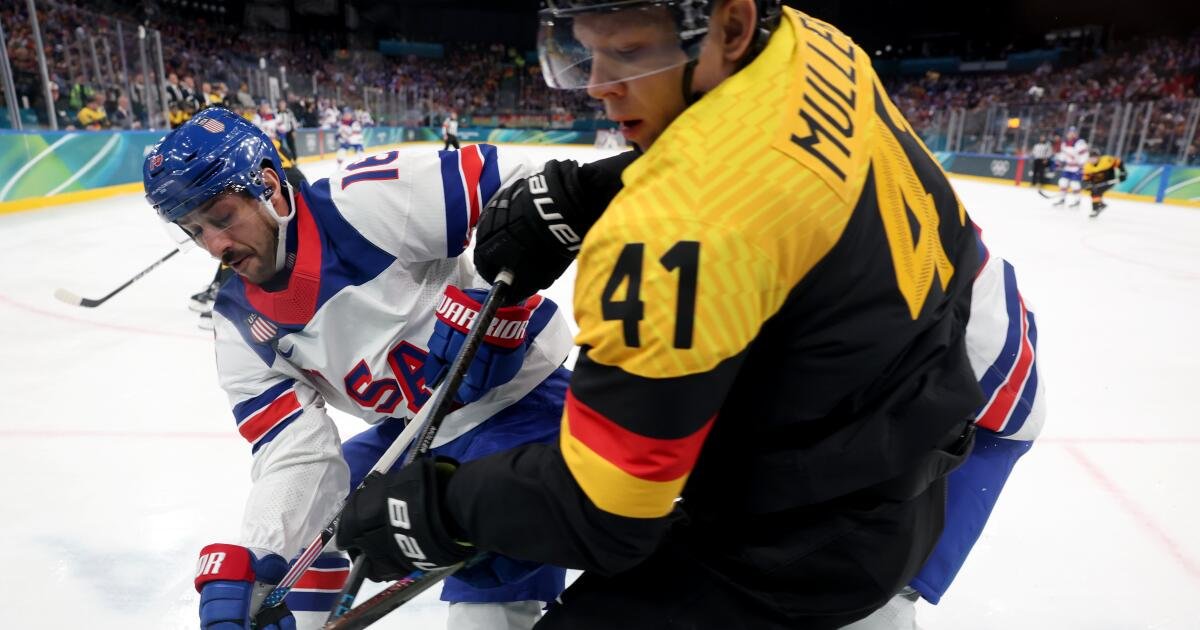
U.S. Men’s Hockey Clinches Unbeaten Record Against Germany in Winter Olympics Group Play
MILAN — NHL players have made their much-anticipated return to the Winter Olympics after a 12-year absence, bringing a familiar atmosphere to the Milan-Cortina hockey tournament. Organizers have executed a series of NHL traditions to enhance the experience, including a horn blast to mark goals and the end of periods, as well as organ music accompanying time-outs. The music selection leans heavily toward American artists like Dean Martin, Neil Diamond, and The Black Eyed Peas.
To further replicate the NHL environment, the tournament enlisted Kings’ organist Dieter Ruehle, creating a setting that seems to resonate well with the players. The United States and Canada, featuring rosters comprised entirely of NHL players, have thrived in this atmosphere, finishing the group stage as the only unbeaten teams.
Canada dominated France with a score of 10-2, with Macklin Celebrini of the San Jose Sharks contributing two goals, securing the top seed for the upcoming quarterfinals. Meanwhile, the U.S. team triumphed over Germany 5-1, earning the second seed, led by Austin Matthews of the Toronto Maple Leafs, who recorded two goals and an assist.
“It’s kind of been familiar to an NHL-style environment, but with the pride of country,” said Boston Bruins defenseman Charlie McAvoy. “The environment that they created here, I think they did an awesome job.”
Jake Sanderson of the Ottawa Senators, who represented the U.S. in the pandemic-affected Beijing Games, noted a significant difference in the atmosphere. “The crowd’s a little bit different than in NHL,” he said, highlighting its more boisterous nature and the visible presence of flags from around the world.
A total of 147 NHL players are participating in the Milan-Cortina Games, with representation from all 32 NHL teams. However, Italy, the host nation, faced challenges, losing all three of its preliminary matches and being outscored 19-4.
NHL players were absent from the 2018 and 2022 Olympics due to disputes over player-related costs and a COVID-19 outbreak that impacted the league’s schedule, respectively. During this period, many countries relied on amateur and lower-tier professional players, leading to skepticism among NHL stars about their Olympic prospects.
“It kind of went to the back of everyone’s mind,” reflected Kings goaltender Darcy Kuemper, a first-time Olympian for Canada. “But then they announced that we’re going to this one. I think everyone got really excited.”
Kuemper, who has already won a Stanley Cup, expressed his aspirations for Olympic gold: “The two greatest honors in hockey are winning the Stanley Cup and winning Olympic gold.”
Looking ahead, Canada will likely need to overcome the U.S. in order for Kuemper to fulfill his Olympic dream. While the U.S. had a shaky start against Germany, they quickly regained composure, with Zach Werenski scoring just before the first intermission, putting the Americans in the lead.
The U.S. continued to assert dominance, with Matthews scoring early in the second period and Faber extending their lead shortly thereafter. The game concluded with goals from Thompson and Matthews before Germany finally found the net courtesy of Tim Stutzle.
As the U.S. prepares for the quarterfinals, McAvoy emphasized the importance of focusing on one match at a time. “We were able to accomplish our goal, get two wins, win the group. That was our goal coming into this,” he stated, highlighting the significance of the added rest before the next round.