Review of ‘Her Private Hell’: How Pino Donaggio’s Score Enhances Nicolas Winding Refn’s Unique Cinematic Journey at Cannes
Nicolas Winding Refn’s latest film, Her Private Hell, reintroduces the director to cinema after a seven-year hiatus following 2016’s Neon Demon and a near-fatal heart condition that led to a 20-minute clinical death three years ago. Surprisingly, the film was excluded from the Cannes Film Festival’s official competition, overlooked in favor of entries resembling 20th-century television. Yet, it stands out as the sole offering from a major director at this year’s festival, hinting at a genuine exploration of cinema’s future amid a landscape dominated by recycled intellectual property and AI-generated tributes to past legends.
Her Private Hell evokes thematic parallels to last year’s Resurrection by China’s Bi Gan, both films opting for an ethereal approach that emphasizes haunting experiences over straightforward entertainment. This artistic choice resonates with ballet, where emotion often trumps traditional storytelling. Central to Refn’s narrative is Pino Donaggio’s remarkable score, which adds depth to the film’s visual grandeur, reminiscent of the silent film era and the works of Powell and Pressburger, even echoing Kenneth Anger’s experimental style.
Watch on Deadline
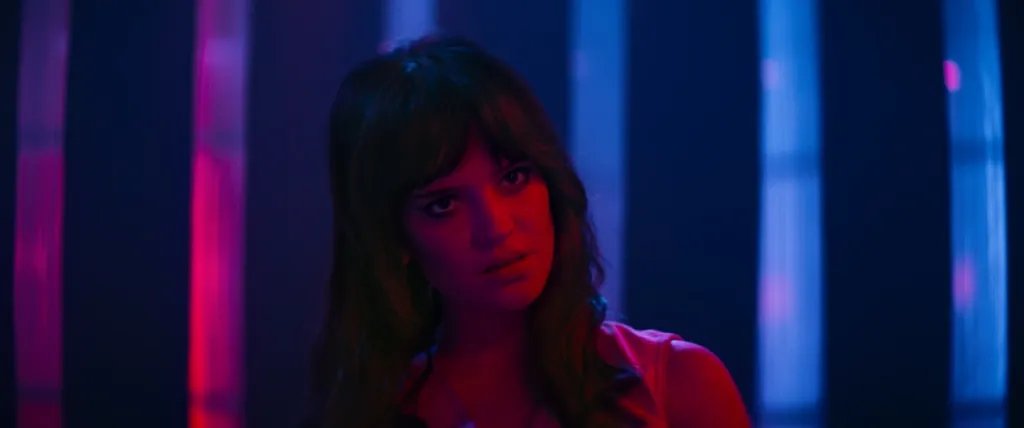
Set in a surreal, futuristic Japanese city, the film centers on Elle (Sophie Thatcher) as she prepares to collaborate with younger influencer Hunter (Kristine Froseth), who is fixated on both fame and Elle. The narrative draws heavily from Ingmar Bergman’s 1966 psychodrama Persona, a perennial source of fascination for genre directors. As they gear up for the shoot, Hunter encounters Dominique (Havana Rose Liu), Elle’s former lover and now married to her father, introducing tensions into their dynamic that Hunter seems oblivious to, or perhaps indifferent about.
The inciting incident occurs when the girls witness a murder in a nearby high-rise, leading to the grisly myth of The Leather Man—a tortured figure reminiscent of Orpheus, who stalks and kills young women, seeking to reclaim his lost daughter. The narrative then transitions to a vibrant space film scene featuring Elle as a leader in a female-driven sci-fi motif, echoing Refn’s earlier aspirations to remake Barbarella.
The story deepens with the introduction of Private K (Charles Melton), an American GI tracking down The Leather Man while avenging wronged women. Though his storyline seemingly diverges from the main narrative, it adds a layer of complexity reminiscent of Refn’s Only God Forgives, suggesting a mystical connection between justice and the eastern setting. There’s an implication that Elle might have conjured Private K as a paternal figure she deeply longs for.
Ultimately, the film’s coherence is ambiguous; Refn challenges viewers to derive the significance of The Leather Man and his cryptic companions (Ms. S and Ms. T). The brilliance of Her Private Hell lies in its refusal to offer concrete answers, opting instead for a tapestry of sensory experiences that resonate on a profound level. The cast infuses this energy into their performances, daring the audience to engage with their characters in an emotionally charged exploration.
Critics may deem the film pretentious, but it embodies a kind of artistic ambition that has been lacking in contemporary cinema. Where once Luis Bunuel was praised for innovative dual casting in That Obscure Object of Desire, today’s filmmakers face scrutiny for less daring choices.
Thought-provoking and divisive, Her Private Hell challenges viewers to make a choice: to embrace its bold artistic vision or to reject it outright.
Title: Her Private Hell
Festival: Cannes (Out of Competition)
Director: Nicolas Winding Refn
Screenwriter: Nicolas Winding Refn, Esti Giordani
Cast: Sophie Thatcher, Havana Rose Liu, Kristine Froseth, Charles Melton
Distributor: Neon
Running time: 1 hrs 49 mins