
How Netflix’s ‘Age of Attraction’ Offers a Fresh Perspective on Dating Shows Traditionally Made by Men
Three of the most successful dating shows in recent history—The Bachelor, Love Is Blind, and Love Island—have all been created by men, with varying degrees of controversy attached to their production.
While there have been a few notable exceptions, such as Singled Out and Too Hot To Handle, these shows were co-created by women but still involved male collaborators.
In a significant shift, Netflix’s newest addition to the genre, Age of Attraction, was developed by two women: Jennifer O’Connell and Rebecca Quinn, co-founders of Velvet Hammer Media.
The series, which premieres its first five episodes tomorrow, March 11, poses the intriguing question: Is love ageless?
The creators aimed to differentiate their show from others, such as MILF Manor, by normalizing diverse dating dynamics rather than sensationalizing them.
Jennifer O’Connell, left, and Rebecca Quinn
“We wanted to normalize it and make it feel, if people, even if they were different stages, if they wanted the same things out of life, that it was okay,” said O’Connell. “We felt we would bring that to the table from the format to casting, and then how the women are portrayed and edited as well.”
Quinn added that their pitch received immediate interest, noting, “Age is just a number is a relatable concept. I think where we had to stay true to ourselves… you can go two ways with this kind of show. One is to poke fun at age gaps, or you can make more of an earnest love story. We’re celebrating it.”
The opening episode features a heartfelt match between a couple of different ages, with the exact age disparity purposely left ambiguous.

Theresa Demaria and John Merrill in ‘Age of Attraction’
The series also interjects humor, as evidenced by one contestant’s quip: “I could date you or your mom,” while another reflects, “I don’t know if these guys are my age, my dad’s age or my grandpa’s age.”
O’Connell remarked, “We cracked a few jokes about Taylor Swift—there’s definitely a cultural difference between generations. Sometimes we kind of touch on that, and I would love to do more of that. But it was never about poking fun at people.”
The creators expressed initial nervousness about how their concept would translate to screen, particularly regarding casting. Quinn explained, “We needed to find people genuinely looking for that perhaps didn’t look exactly their age.”
There was extensive debate about casting logistics, balancing the desire to follow individuals from various locations with the practicality of proximity. “We were pretty adamant it had to be nationwide…no way could we limit it to one city,” Quinn stated, praising the success of this decision.
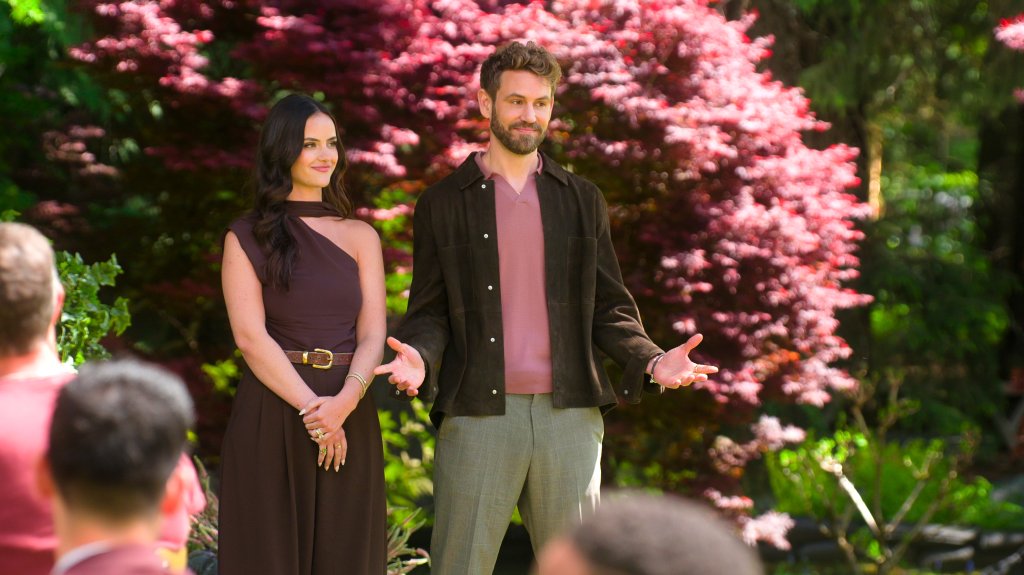
Hosted by Nick Viall, a former contestant of The Bachelor, the series also features his wife, Natalie Joy. The show was filmed in scenic locations between Whistler and Vancouver, leveraging Canadian tax credits. O’Connell noted, “We wanted to stand out a little bit, but also find a place that’s really beautiful… we were trying to create a very high-end resort type situation.”
Initially, Velvet Hammer aimed to feature 40 singletons, with 14 couples emerging by the end of the first season, most of whom had age differences. The final series tracked six couples.
Quinn mentioned their ambition for the format, saying, “We wanted this to be a new format that has legs that could go on for a long time… this was a true experiment.”
Rather than revealing contestant ages upfront, ages are disclosed only in the Promise Room, a decision that fostered significant discussion during development. O’Connell explained the contrasting viewpoints around this creative choice.
Reflecting on the rollout strategy, Netflix plans to release the series in three phases, with episodes dropping on March 11, 18, and 25.
The creators believe ample opportunities lie ahead for dating shows in the current market, especially as long-standing series like The Bachelor and Love Is Blind continue to capture audiences.
O’Connell concluded, “Love is aspirational. It’s just super relatable, and there’s a whole new generation of viewers now that love dating shows.”
Beyond dating shows, Velvet Hammer has produced various genres, including food programming and true crime. Quinn expressed excitement for future projects, noting, “Our next mission is the big physical competition show… how would a Wipeout be from our POV? Because it would be different and a swing.”