
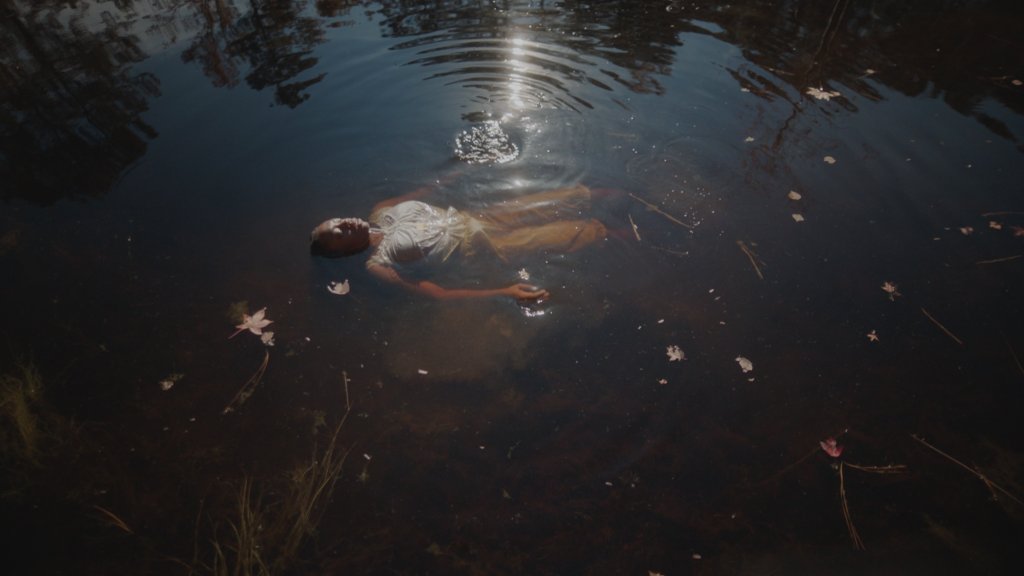
Allison Janae Hamilton Shares Insights on Her New Film ‘Venus of Ossabaw’ and Her Vision for Engaging Audiences with ‘Floridaland’
Filmmaker and artist Allison Janae Hamilton, renowned for her engaging explorations of Black life and womanhood rooted in the environmental histories of the American South, is set to unveil her inaugural cinema project, Venus of Ossabaw. The film will debut this month at the Telfair Museum of Art in Savannah, Georgia.
Set in the late 18th century, Venus aligns with Hamilton’s signature wilderness narratives. The film chronicles the journey of a teenage girl who escapes captivity on Ossabaw, a barrier island off the coast of Georgia, traversing the perilous landscape of South Georgia in a bid for freedom in Spanish Florida.
Inspired by the true story of Titus, an enslaved man who fled Ossabaw in the late 1700s and established a community with other self-emancipated individuals, the film was filmed on the island, currently owned by the State of Georgia and uninhabited.
“We shot two days on the island, and then we shot two days in the Savannah area,” Hamilton shared. “The whole crew slept there overnight. It was one step up from camping. We were in this dormitory situation. I joked that it was like Burning Man, because we had to bring everything there and take everything off, even our trash. It was a wild experience, but a great one.”
Hamilton also articulated her ambition to broaden her creative horizons. “I want to challenge myself to make projects that could live in a more popular arena,” she explained.
Her first feature film, Floridaland, is in development and was recently workshopped at the Sundance Film Festival as part of the Screenwriters Intensive, which has produced notable alums like Reinaldo Marcus Green and Laurel Parmet.
Throughout her varied career, Hamilton has showcased her work at esteemed venues including MoMA, MASS MoCA, the Studio Museum in Harlem, and the BlackStar Film Festival. Her single-channel video piece Wacissa has been acquired by the Smithsonian. Hamilton holds an MFA from Columbia University and a Ph.D. from NYU.
In a recent discussion, Hamilton delved into the creation of Venus and her upcoming feature, Floridaland, highlighting her goal of reaching broader audiences and her desire to engage more deeply with the traditional cinema space.
Venus of Ossabaw is set to premiere on March 13 at Telfair’s Jepson Center in Savannah.
DEADLINE: How did this project happen? I assume Telfair Museums contacted you with the commission?
ALLISON JANAE HAMILTON: Yes, they invited me to make an artwork about the island. I think they thought I was probably going to make a painting or something. But the island has such a rich history. The location is so similar to where I’m from. It has the same feel, so I decided to make a moving-image-based project to allow the viewer to be immersed in the island. I also came across a book by Paul Pressly about what he described as the Southern Underground Railroad, where, for a period of time, enslaved people would try to get to Florida and join the Catholic Church to gain freedom. I was so fascinated by that history. I wanted to create a piece to think through that history.
DEADLINE: Yeah, there is something to be said about how distinct the South feels. I traveled the South for the first time recently after spending lots of time on the coasts, and it really does feel different.
HAMILTON: Absolutely. I had the opposite experience. I moved to New York City when I was 22, and I felt like I had moved to another country. It was so different. There’s so much about the landscape that’s just embedded in the experience. I was reading about the experiences of early explorers to the South, and they thought that the 35th parallel, which runs from North Carolina through Memphis, was where God had placed the Garden of Eden. Today, there are still towns that take their names from this history. There’s a town near where I’m from called Tate’s Hell, because they thought that’s where hell was. There are so many ways identity and place are intertwined. In some cases, in almost comical ways. The landscape is in the culture, and the culture is in the landscape.
DEADLINE: What does research for a film like this look like? Were you familiar with the island beforehand? Had you been there?
HAMILTON: I wasn’t familiar with the island. I hadn’t been there because it’s not inhabited, so you can only get there by boat. In terms of research, we worked closely with the Ossabaw Island Foundation. I also read a lot of primary source materials, like narratives, alongside secondary texts such as Paul Pressly’s historical document. I love doing lots of research for my projects and allowing my audience members to be as suspended as they choose. It’s like a choose-your-own-adventure. I do all the heavy lifting, and hope the viewer will gain something, whether that’s through color or sound, or they can go on a deeper dive with me.
Allison Janae Hamilton’s ‘Venus of Ossabaw’. Credit: Allison Janae Hamilton.
DEADLINE: And from what I understand, Venus will screen on the side of the Telfair Museum?
HAMILTON: There are two versions of the film. The first is the main narrative short that will screen on a loop in the gallery in a theater context. Hopefully, we’ll put that version into the festival circuit after this exhibition. The second iteration takes all the landscape and atmospheric elements of the film and strings them together in a different edit to be viewed on a large scale as a public art installation, which you can stumble upon on the building’s façade. It’s a very immersive experience of the landscape.
DEADLINE: You mention the festival circuit. And you were just at Sundance Labs. Why have you decided to move further into the traditional cinema space?
HAMILTON: I have made films for so long in the context of the contemporary art world, and I have enjoyed it so much. I’m thrilled to wake up and do what I do every day, especially because I come from a very rural agricultural background. But I wanted to push myself and think about another way to tell stories. Not everybody goes to museums and galleries. Many people don’t feel comfortable. One of the elephants in the room of the art world is that it’s not the most welcoming, democratic, or accommodating place. I want to challenge myself to make projects that could live in a more popular arena.
DEADLINE: Do you think the traditional cinema space will change the way you work? I’m thinking about the intellectual and philosophical patterns of your work.
HAMILTON: It’s not going to change the way I work, but it will stretch me because for a movie, there is a balance to maintain. There has to be some sort of plot, whereas in the art world, you can do whatever you want. But I’m always going to be invested in really lush visual experiences that center the landscape. And while landscape is seen as a backdrop in traditional narrative cinema, it is the forefront in my work. It’s an entry point for me. It’s my entry point to my identity. It’s my entry point to Black womanhood and Americanness. It all comes through the natural world and the environment of the Southern land.
DEADLINE: And you were at Sundance with your feature project, Floridaland, which is a work in progress. You have a gallery piece with the same name. Are the two pieces related?
HAMILTON: The multi-channel installation, Floridaland, was part of my first museum solo at Mass MoCA. That piece explores Florida as a place and the myths surrounding it. It’s a fully immersive experience of everything I feel and know about the landscape and the chaos that was happening at that time. Now I’m working on a narrative feature, Floridaland, which takes that same idea of grappling with Florida as a very real place and also the surplus of reality.
It’s a magical realist story about a young woman college student enrolled at a fictionalized version of my undergrad alma mater, Florida State University. She has the empathic gift of sight and is navigating life between campus and her family’s failing casino business. It’s a story that encompasses many different elements of Florida. It’s similar to that first installation and all my work insofar as it’s based on history and contemporary reality. But it also has a magical and haunting appeal. And it’s set in the early 2000s, which was just an amazing time to be in college in Tallahassee. So it’s against the backdrop of the glitz and glamor of early Southern hip hop. The soundtrack will be amazing.
DEADLINE: How are you finding the process of putting a feature project together?
HAMILTON: I’m still learning. I’ve built my career in the contemporary art space. Venus is my first cinema project, and with the feature, I’d like to see where it goes. I would love to have this story told in a broader sense. I see this as a project for theaters. I see it as a project where audiences who are not necessarily contemporary art viewers would go and see it because the stories of the region and the experiences of young Black women deserve conversation. I’d love for those conversations and experiences to be shared widely.