
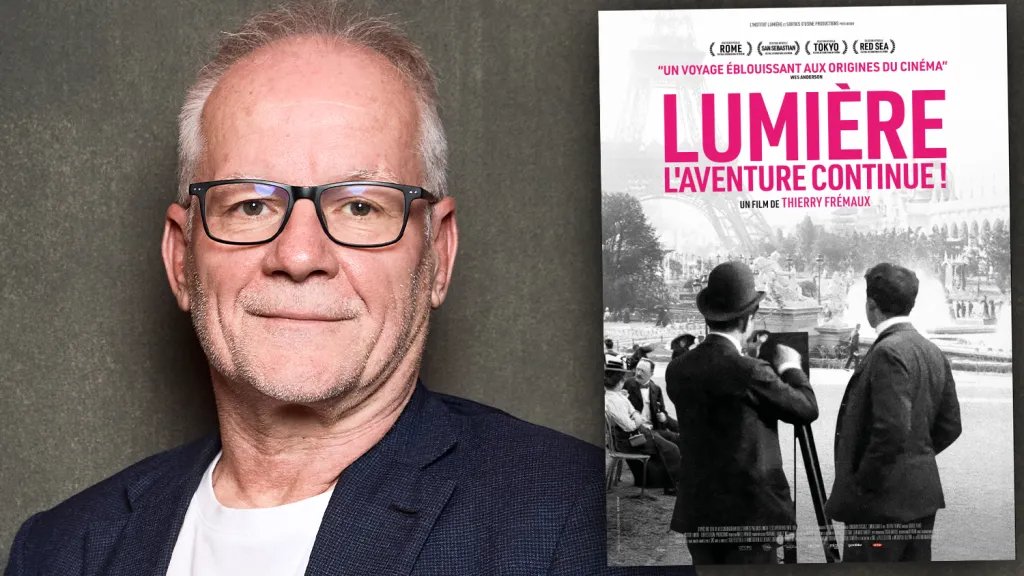
Cannes Chief Thierry Frémaux Discusses His Documentary ‘Lumière, Le Cinéma!’ and the Future of Film
The U.S. is known for its Wright brothers, while France boasts its own pioneering duo: the Lumière brothers.
In the years leading up to Orville and Wilbur Wright’s first flight, Auguste and Louis Lumière were shaping the future of cinema. Beginning in 1895, the brothers created some of the earliest motion pictures using equipment they designed themselves.
“When [Louis] Lumière turned the crank of a beautifully crafted metal and wooden device, the technical achievement of his invention made history,” notes Thierry Frémaux, director of the Cannes Film Festival. Frémaux discusses this in his documentary, Lumière, Le Cinéma!, which is currently screening in select U.S. cities through Janus Films. The film debuts in Los Angeles on April 25 and is set to stream on the Criterion Channel starting May 1.
In the documentary, Frémaux guides viewers through numerous newly restored short films by the Lumière brothers, including their iconic 46-second film, La Sortie de l’usine Lumière à Lyon (Workers Leaving the Lumière Factory), shot outside their factory as the workday concluded.
Watch on Deadline
Stills from Lumière brothers films, including ‘Workers Leaving the Lumière Factory’ (at center).
These early films were pivotal in establishing a cinematic language.
“One hundred and thirty years ago, the Lumière brothers invented the cinématographe,” Frémaux explains in his narration. “Everything was already there: comedy, drama, actors’ performances, children’s faces, tracking shots by boat, and panoramas by streetcar.”

Portrait of the Lumiere brothers, Auguste (left) and Louis, on December 28, 1895 in Paris. (Photo by: )
As the primary cameraman, Louis Lumière was not merely capturing random shots.
“[Louis] Lumière knew nothing about cinema, so he had to invent his own behavior, his own way to make cinema,” Frémaux elaborates. “The first question was, where do I put the camera? What do I do with it? What is cinema?”
A Lumière brothers short film featuring young acrobats.
Frémaux emphasizes, “Every Lumière film is directed. Because they could not view through the camera, they had to think about what they wanted to film, making it a mise-en-scène; everything is directed.”
Notably, Georges Méliès, another trailblazer in cinema, attended the Lumières’ first public exhibition. While Méliès ventured into fantasy and science fiction, the Lumières often depicted real-life moments in their films.
Frémaux explains, “Méliès came from a world of magic theater. Lumière had no such agenda; he made cinema for what it was. This is why the essence of cinema is more present in Lumière than in Méliès. While both paths are essential, historically, we note that ‘Lumière is documentary and Méliès is fiction.’ But Lumière captures the poetry of life.”
Thierry Frémaux at the 77th annual Cannes Film Festival at the Palais des Festivals.
Frémaux, also director of the Institut Lumière in Lyon, highlights the brothers’ foundational role in the film industry, particularly in championing film exhibition, which became crucial in the 20th century.
“The two inventions of Lumière are cinema as an art and the movie theater as a place for audiences,” Frémaux asserts. “A film cannot exist without an audience. While cinema is now ubiquitous across mediums, the theater experience remains unique.”
Frémaux warns that streaming poses significant challenges for traditional film exhibition, citing the Cannes Film Festival’s insistence on theatrical releases for Palm d’Or contenders as a response to the rise of platforms like Netflix.
“In the 20th century, people traveled to theaters for films. Today, especially in the U.S., the rise of streaming has transformed viewing habits,” he says. “In a sense, it reflects a return to Thomas Edison’s original vision of individual film consumption, contrasting with Lumière’s dream of communal viewing.”
An early Lumière brothers film.
While Lumière, Le Cinéma! will be available for streaming on Criterion Channel, Frémaux emphasizes the importance of viewing it on the big screen.
“Restored films in good condition offer a richer experience,” he asserts. “Seeing Lumière films on a large screen showcases their full potential, making even the oldest film fascinating in that setting.”