

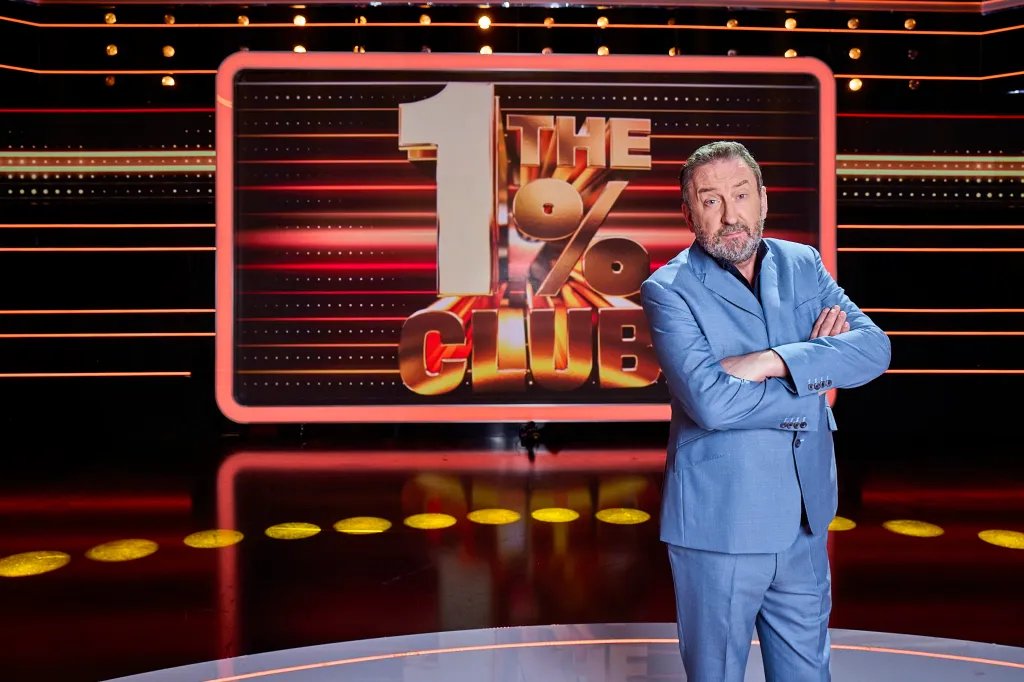
The 1% Club Strengthens Its Status as Leading British Format with New Deals in Sweden and Italy
The 1% Club Expands International Reach with New Sales in Sweden and Italy
LONDON – ITV’s quiz show The 1% Club has made headlines by successfully selling its format to Sweden and Italy, solidifying its status as the top-selling new UK format of the past decade, according to BBC Studios.
Featuring 100 contestants competing to answer questions that only 1% of the population are expected to get right, The 1% Club stands out as the leading British-made original, outperforming its peers over the last eight years.
The Swedish adaptation will be produced by BBC Studios Sweden Productions for public broadcaster SVT, while Mediaset will produce the show’s Italian version through Blu Yazmine. This brings the total number of worldwide adaptations to 15, coinciding with the upcoming BBC Studios Showcase in London, where The 1% Club is expected to be a major highlight.
Sumi Connock, Executive Vice President of BBC Studios’ Global Creative Network and Formats, remarked that The 1% Club demonstrates that quiz shows can reclaim their dominance in primetime television. The UK and Australian editions, hosted by Lee Mack and Jim Jefferies respectively, have particularly solidified their places in the Saturday night lineup.
"Territories often feel compelled to feature high-profile entertainment shows like The Voice or Dancing with the Stars, but few have the confidence to place a gameshow at the core of their schedule," Connock noted. She credited the Seven Network in Australia for successfully integrating The 1% Club into their programming, marking it as their top show upon its release.
Connock expressed optimistic hopes for the new Swedish and Italian versions to enjoy similar success, attributing the show’s universal appeal to its repurposable format and interactive nature. "The set gives it a very strong visual identity," she explained, highlighting the adjustments made to accommodate different studio sizes, thus broadening access to international markets.
Andy Auerbach, the show’s co-creator alongside Dean Nabarro at Magnum Media, pointed out a growing appetite for brain-teaser questions in contemporary entertainment, inspired by puzzles like Wordle. He noted how audiences engage with the format, often requesting to tackle more questions. "It was almost like an addiction," Auerbach remarked.
The show’s unique approach resonates across generations, with Auerbach emphasizing instances where younger contestants outperformed older partners on specific questions. "If a 12-year-old can beat their parents at this game, then this concept has strong potential," he added.
Despite a landscape increasingly filled with international formats, The 1% Club has managed to maintain a significant following in the UK, currently in its fifth season with impressive ratings. Connock acknowledged the challenges UK-produced shows face, citing cost factors that can complicate international expansion.
"Sometimes international territories have implemented more cost-effective strategies," she observed, highlighting issues surrounding the originality of formats.
However, The 1% Club experiences a remarkable return rate worldwide, with only one adaptation, in Mexico, being cancelled after one season. The format continues to thrive in the UK and is expected to feature prominently in the forthcoming week of programming.
In the United States, The 1% Club has also been greenlit for a third season. After undergoing significant changes, the show promises to follow a similar hosting structure for its next installment, maintaining its presence across various platforms.
Connock affirmed the flexibility of the show’s format, indicating that having formats available on different streaming services and networks does not necessarily detract from viewership. She cited Dancing with the Stars as an example of this successful model.
The series has also leaned towards utilizing comedian hosts, although Connock indicated that new markets in Sweden and Italy may consider alternative presenters.
As the production team explores potential spin-offs and brand extensions, Auerbach’s plans include a kids’ special and a digital extension on smart TV platforms. Additionally, plans for a show inspired by the concept of crowd intelligence are in development, showcasing the ongoing innovation in BBC formats.
Auerbach concluded by expressing confidence in the UK’s willingness to take creative risks, advocating for the unique appeal of The 1% Club as a fresh entry into the television landscape. "For ITV to take a risk on a tiny company and commission a brand new show off paper…it seems risky in retrospect," he noted.