
Bryan Cranston Celebrates Stellan Skarsgård and Joachim Trier in a Special Love-In Event
Following its enthusiastic reception at the Cannes Film Festival last May, where it garnered a remarkable 19-minute ovation, director Joachim Trier expressed his gratitude for the support of BBC Film. At an after-party, attended by Eva Yates, director of BBC Film, Trier reflected on the collaboration that enabled the film to flourish.
“They were very supportive,” Trier remarked about BBC Film’s involvement. “Very, very smart people when it comes to script and editing and creative input, and really also very generous and respectful. So I found that collaboration very valuable and it made it possible for us to have more money and work more with the actors and have more on the screen.”
He added that Sentimental Value has exceeded their expectations in terms of success, crediting local distribution efforts for its impact. “Yesterday, I felt this embrace from a community outside of Norway. And my joke is that Norway is the suburbs of Europe. So for me, I’ve learned from this,” Trier said.
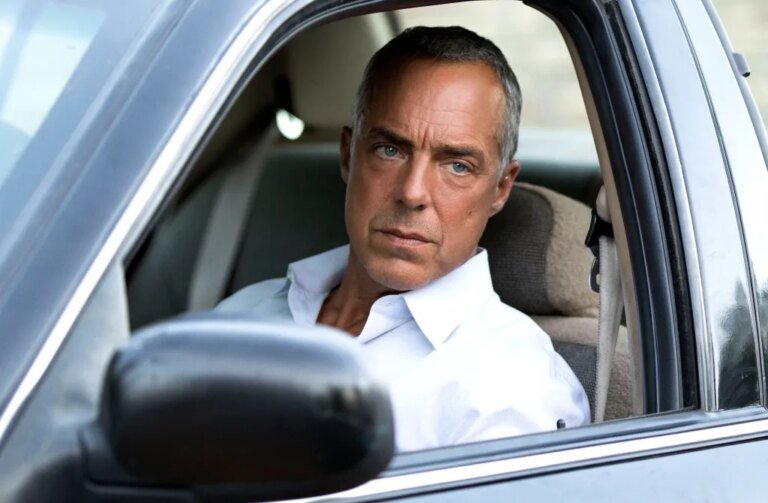
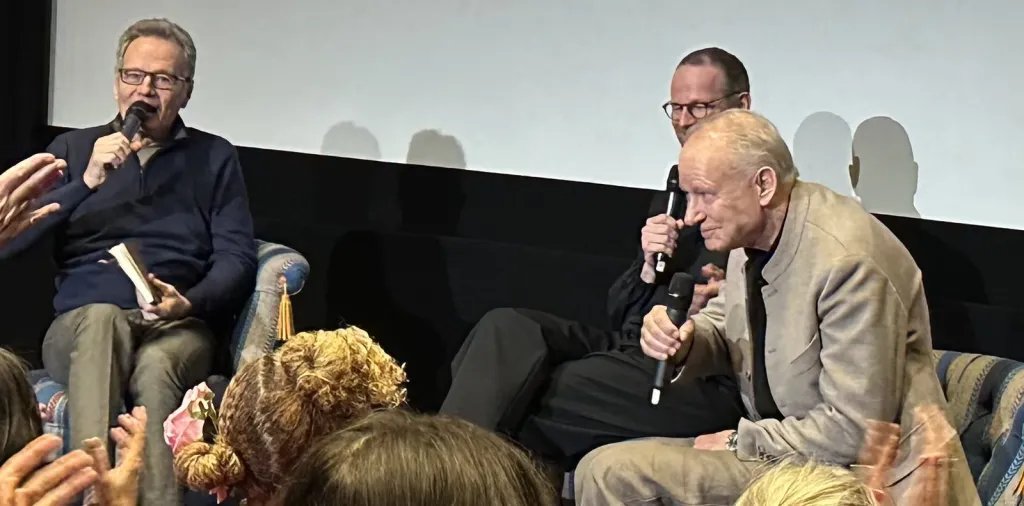
The discussion took place at London’s Soho Hotel following an awards Q&A session featuring Trier and actor Stellan Skarsgård. Moderated by Bryan Cranston, known for his role in Breaking Bad, the panel highlighted the film’s compelling narrative. Cranston, who described himself as a “fan of fans,” praised the film’s intricate story revolving around Gustav Borg, portrayed by Skarsgård, who attempts to reconnect with his two adult daughters after their mother’s death.
The film explores the generational trauma affecting a father and his psychologically wounded children, set against the backdrop of the film industry. Trier has posited that a background of trauma may be essential for filmmakers. Cranston likened Sentimental Value to “one of those Russian dolls that you open up, and there’s another thing inside another,” emphasizing its layered storytelling.
In the Q&A, Cranston inquired about the inspiration behind the storyline. Trier explained that the idea stemmed from two grown sisters negotiating their familial narratives, referencing Joan Didion’s observation: “We tell ourselves stories in order to live.” He shared his gratitude for being a father to young daughters, which has deepened his understanding of such narratives.
As the conversation unfolded, Skarsgård illustrated the actor-director synergy, noting his initial hesitance to read Trier’s script: “Good directors, they’re really rare…even if the role isn’t that good, you get a good experience from it.” Cranston questioned Skarsgård on the necessity of research for the role, to which Skarsgård replied that while the character could be an artist of any kind, finding the nuances of Borg’s personality was essential.
Cranston, meanwhile, is currently starring in a revival of Arthur Miller’s All My Sons. During the talk, he raised a question about the film’s depiction of theatrical disdain, wanting to know if it matched Trier’s personal feelings. Although Trier identified himself as a “film guy 100%,” he disclosed his admiration for theater, influenced by his wife, an architect and occasional stage designer.
Skarsgård expressed a love for theater, albeit acknowledging its difficulties. In a discussion following the Q&A, he mentioned the extensive time he spent in theater early in his career, highlighting his support for the stage.
When asked about how his experiences as a father informed his performance as Borg, Skarsgård clarified that his parental responsibilities, which included caring for his children, did not affect his portrayal but provided a rich backdrop to his life experiences.
On the subject of awards season, Skarsgård remarked, “It has two sides. On one hand you appreciate the love of your peers and of the audiences, especially when the film gets warm responses and interesting discussions. But on the other hand, as an actor, you’re a whore…doing publicity is a little painful.”
In the closing moments of the Q&A, the three discussed the film’s “beautifully delicate ending,” which offers a sense of reconciliation. Cranston concluded with a line from the movie, reflecting on its unique quality: “They just don’t make movies like this anymore. And the same could be said for Sentimental Value. They don’t make movies like this anymore, but yet they do.”
(L/R) Bryan Cranston, Joachim Trier, and Stellan Skarsgård share a joke. Baz Bamigboye/Deadline
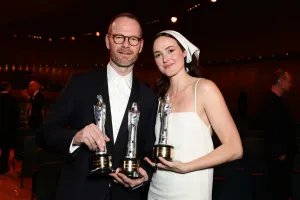
Joachim Trier and Renate Reinsve pose at 38th European Film Awards in Berlin
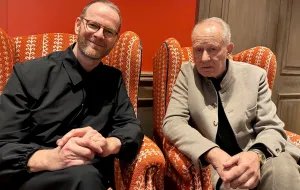
Joachim Trier and Stellan Skarsgård. Baz Bamigboye/Deadline

Stellan Skarsgård. Baz Bamigboye/Deadline