

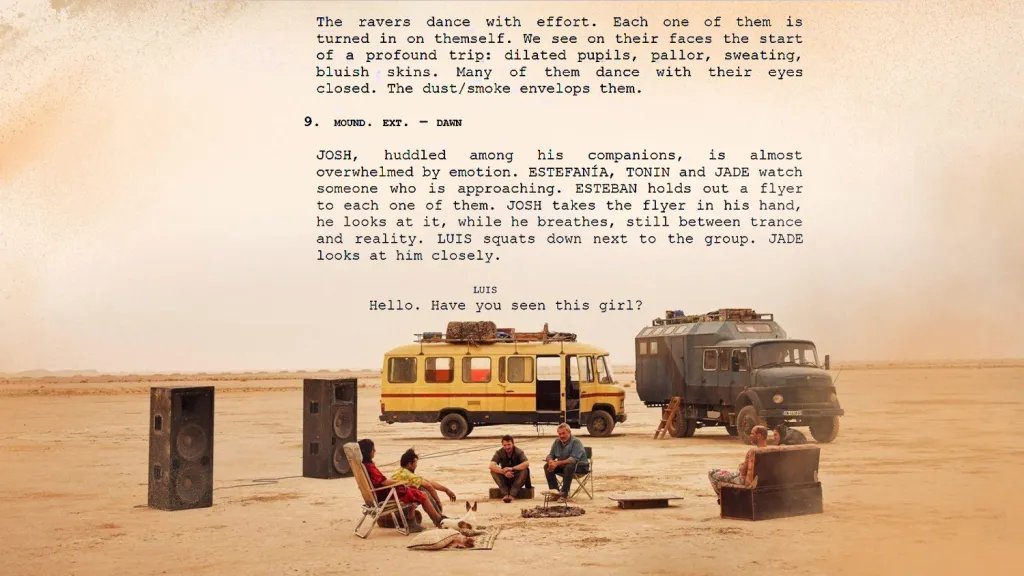
Explore the Screenplay of Oliver Laxe’s Cannes-Winning Film ‘Sirāt’: A Journey Through Existentialism and Desert Raves
Neon to Release Sirāt in February After International Acclaim
Neon has scheduled the U.S. release of Sirāt for February 6, following a successful run in Spain and France. The film has garnered nominations for Best Foreign Film from several prestigious organizations, including the Gothams, Critics Choice, Indie Spirits, and the Golden Globes. Additionally, it received nine nominations at the European Film Awards.
Set against the backdrop of an illegal EDM rave in the Moroccan desert, Sirāt tells the story of Luis (Sergi López), a desperate father searching for his missing daughter, Mar. Joined by his young son, Esteban (Bruno Núñez Arjona), Luis sets out to distribute flyers in hopes of finding her, whose fate seems intertwined with the transient rave culture. The search takes a chaotic turn when local authorities raid the party, intensifying the atmosphere with unsettling news of a burgeoning global conflict.
Despite the challenges, Luis remains determined, believing that Mar may be at another rave near the Mauritanian border. In a reckless move, he and Esteban attach themselves to a group of ravers, embarking on a treacherous journey through the harsh Saghro desert. What begins as a straightforward quest transforms into a profound test of endurance, pushing both father and son to their physical and emotional limits. The narrative reaches a turning point when a shocking event alters Luis’s understanding of his situation and actions.
At its core, Sirāt focuses on the emotional evolution of Luis. Initially depicted as a burdened father, his quest represents a bridge to conventional life, contrasting with the radical freedom embodied by the ravers. These individuals, often bearing physical scars, embrace a lifestyle detached from societal norms, seeking transcendence through collective experiences. As the journey progresses, Luis and Esteban gradually integrate into this alternative community, prompting Luis to let go of his desperation in favor of a more fatalistic acceptance.
The film explores profound themes woven into both metaphysical allegory and contemporary societal critique. The title Sirāt invokes the razor-thin bridge in Islamic thought connecting paradise and hell, symbolizing the characters’ precarious journey between destruction and renewal, reality and metaphor.
Ultimately, Sirāt is an existential exploration of humanity’s pursuit of meaning and connection on the fringes of society. The rave culture serves as a modern pilgrimage toward epiphany and self-loss through dance. Set against the vast Moroccan desert—an indifferent character in its own right—the film forces the characters to confront mortality and the elemental forces of nature. The contrasting desires of Luis to reunite his family and the ravers’ quest for radical freedom reflect a deeper commentary on escapism in the face of global turmoil, suggesting that their journey into the wilderness is a search for significance at the "end of the world."