
Wyclef Jean Shares His Journey After Thirty Years
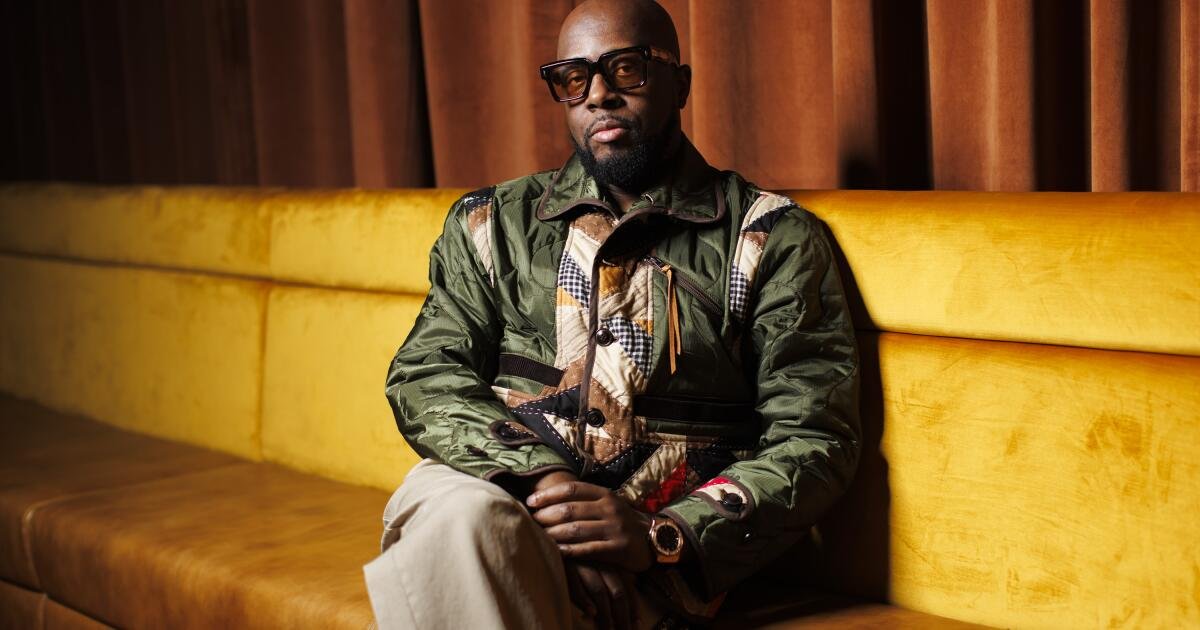
Backstage at the Blue Note jazz club, Wyclef Jean relaxes on a couch, exuding a laid-back charm reminiscent of a sun-warmed cat. His refreshments consist solely of healthy options: granola bars, melon slices, and grapes that resemble ping-pong balls. A faint scent of marijuana wafts through the air. When asked if he still smokes, Jean replies with a nod: “Do fish swim?”
The duality of Jean’s persona is evident as he describes himself: “the peaceful one here, and the bonkers one onstage.” For now, the playful spirit remains dormant, occasionally hinted at through his dark sunglasses.
This moment comes shortly after the passing of John Forté, a close friend and collaborator who contributed significantly to the Fugees’ successful sound but often went uncredited. “We would talk all the time,” Jean reflects, recalling his last text to Forté: “Yo, text me, so I know you okay?” There was no response. “He had this smile that shook the universe,” he adds, his voice tinged with sorrow.
Memory has emerged as a driving force in Jean’s artistic expression. The performance marks the second night of his five-night residency at Blue Note Los Angeles, featuring a theatrical reimagining of his life and career. The show traverses an eclectic range of musical styles, including Haitian rara, boom-bap, reggae-infused ballads, and rock guitar theatrics, with an audacious guitar solo where he humorously performs cunnilingus on his instrument. This theatricality aligns with his upcoming seven-part project, “Quantum Leap,” which harks back to his origins.
Over the past three decades, Jean has cemented his status as a pivotal figure in modern pop music, blending diverse sounds—hip-hop, Jamaican reggae, Haitian kompa, gospel, salsa, and folk—into vibrant, socially conscious compositions. His ability to foresee the global music landscape predates current terminology, though his profound influence is often overlooked.
As a solo artist, Jean has released nine albums, collectively selling over 9 million copies worldwide. His debut, “The Carnival,” launched in 1997, was followed by the 2000 album “The Ecleftic: 2 Sides II a Book,” which notably transformed wrestling icon The Rock into a pop sensation with the track “It Doesn’t Matter.” Despite numerous accolades, Jean expresses a sense of being misunderstood. “I still don’t feel like the world’s figured me out yet,” he remarks, drawing a parallel to Bob Marley, who famously won no Grammys despite being a colossal artist.
With “Quantum Leap,” Jean aims to offer a more precise portrayal of himself. This ambitious project consists of seven albums, each released monthly and centered around a specific genre—hip-hop, reggae, jazz, country, Haitian kompa, and R&B—each linked to a significant moment in his career. “You find inspiration in your origin,” he notes, highlighting the extensive five-year development process behind the project.
Born in Croix-des-Bouquets, Haiti, Jean’s early life was filled with hardship; he was forcibly removed from his mother at birth. Raised in a country where many subsist on less than a dollar a day, he experienced profound poverty. At the age of 9, his family relocated to Brooklyn’s Marlboro Projects, where he spoke Creole at home and learned English at school.
Inspired by Grandmaster Flash, he began freestyling as a teenager, initially rehearsing in private before performing for peers. “All I ever wanted,” he says, “was for people to hear me.” Despite his father’s disapproval of rap, Jean embraced the identity of “the preacher’s son,” incorporating biblical references into his verses, a theme that continues with “Quantum Leap.”
By 13, he was directing his church’s choir. His music teacher, Valerie Price, discovered him playing guitar alone in the school auditorium, asking, “Where did you learn this?” to which he confidently replied, “I can just see it in my head.” While initially resistant to learning jazz, Jean eventually grasped that both jazz and rap could coexist in his creative journey—a notion he attributes to Price’s influence.
After moving to New Jersey, Jean built a makeshift studio in his uncle’s basement, producing hip-hop tracks and crafting the score for an off-Broadway play that caught the attention of Quincy Jones. It was during this time that he met Lauryn Hill, with whom he would co-found the Fugees alongside his cousin Pras.
The Fugees created one of hip-hop’s most iconic albums, “The Score,” in that same basement studio. While Jean retains demo recordings from those sessions, he has opted not to release them, comparing their legacy to that of renowned bands like The Beatles and Pink Floyd: “I would never want to change the perception of ‘The Score.’” He adds that there was never any discussion of a sequel, asserting: “Basquiat never duplicated his paintings.”
The relationship between Jean and Hill, both creatively and romantically charged, became tumultuous, culminating in a much-publicized incident aboard an airplane followed by years of silence. Reflecting on whether he ever wanted to reach out to Hill, he states: “Always,” but acknowledges that “the universe” held them apart. Now, he describes their current rapport as positive; he is affectionately known as “Uncle Wyclef” to her children. Their recent onstage reunions, including a performance of “Killing Me Softly” at the Grammys, signify a thawing of old tensions. “I think this reconciliation between me and Lauryn is one of the best things that could possibly happen to the planet,” he reflects.
Jean is acutely aware of his influential role in bridging musical genres, as evidenced by younger artists like Young Thug and G Herbo referencing him in their works. “Very few of us can connect those bridges,” he observes.
His impact resonates profoundly within Haiti, where he has long served as a cultural ambassador. In 2010, he made an unsuccessful bid for the presidency, a decision he reflects on with bemusement, stating: “There was no course in poly-sci that could have prepared me for that.” Through this experience, he gained insight into Haiti’s dire geopolitical challenges.
However, Jean prefers not to dwell on polarizing political remarks involving Haitian immigrants, emphasizing that he views them as distractions from more pressing issues. “If there’s a comment, I make a statement, then I keep it moving,” he says. He identifies as a centrist, describing his approach as “riding the middle.”
At the Blue Note, Jean embodies a celebration of Haitian heritage, delivering a vibrant performance that counters the nation’s stark realities of poverty and political strife. His band, primarily composed of Haitian preachers’ children steeped in gospel tradition, contributes to the festive atmosphere. “Go crazy!” Jean implores the crowd repeatedly, and they enthusiastically oblige.
Despite his commanding stage presence, Jean remains accountable to higher standards. Recently, Price attended one of his concerts with a notebook, grading his performance as she watched. “It still put the fear in me,” he admits, a smile spreading across his face as he recalls her feedback: “She gave me an A.”