
Understanding Why Senator Jon Ossoff’s CBS Appearance Doesn’t Trigger FCC Rules, While James Talarico’s Might
Late-night television is embroiled in another controversy involving the Federal Communications Commission (FCC).
On Monday, The Late Show host Stephen Colbert revealed that CBS lawyers had barred him from featuring Texas state representative James Talarico during a recent episode. This decision stems from new guidance issued by FCC chairman Brendan Carr regarding the “equal time” provision, which mandates that networks must provide airtime to rival political candidates upon request.
“[James Talarico] was supposed to be here, but we were told in no uncertain terms by our network’s lawyers, who called us directly, that we could not have him on the broadcast,” Colbert stated. “Then, I was told, in some uncertain terms, that not only could I not have him on, I could not mention not having him on—and because my network clearly doesn’t want us to talk about this: let’s talk about this.”
However, CBS provided a different perspective on the situation. In a statement issued on Tuesday, the network clarified that it did not “prohibit” The Late Show from broadcasting the Talarico interview. The statement outlined that the show received legal advice indicating that airing the segment could invoke the FCC’s equal-time rule for two other candidates, including Rep. Jasmine Crockett. Consequently, the show opted to share the interview via its YouTube channel, promoting it on-air, rather than navigating the complexities of equal-time obligations.
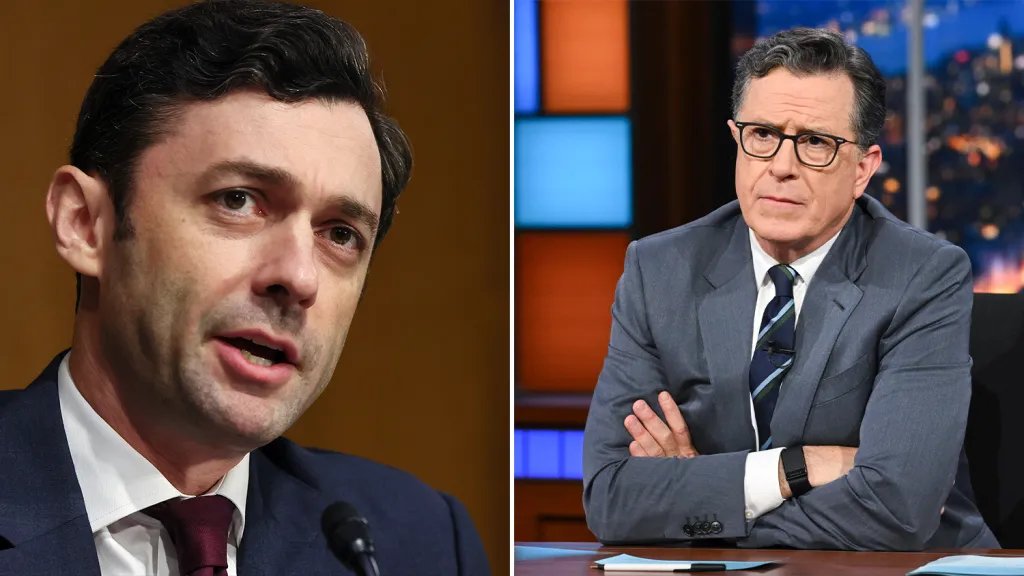
This controversy arises as The Late Show prepares to welcome another political figure: Georgia Democratic Senator Jon Ossoff, who recently made headlines by calling President Trump “spiritually broken.”
Given Colbert’s concerns over CBS lawyers restricting an interview with Talarico, questions arise as to why he is proceeding with the Ossoff interview, especially since Ossoff is also up for reelection this November.
The distinction lies in FCC regulations. In January, Carr delineated that Congress established protections ensuring equal access to broadcast facilities for legally qualified candidates.
Talarico, running for the U.S. Senate in Texas, qualifies as a “legally qualified candidate” as he competes against Jasmine Crockett and Ahmad Hassan in the upcoming Democratic primary on March 3. Conversely, Ossoff has announced his intention to run for reelection, but the qualifying period for Georgia primaries does not begin until March, allowing him to appear on The Late Show without prompting CBS to accommodate rival candidates.
A similar scenario unfolded last month when Pennsylvania Governor Josh Shapiro appeared on The Late Show to promote his memoir. Although he had announced plans to run for re-election, he was not yet deemed a “legally qualified candidate” at the time of his January 26 appearance.
On his last episode, Colbert appeared to challenge the decisions made by CBS lawyers regarding the FCC rules, suggesting they were motivated by financial interests, a nod to the network’s recent restructuring plans.
He also humorously commented on one of CBS’ popular scripted shows, stating, “Matlock: watch it or don’t watch it. I leave in May.”
With tensions high, questions about CBS’s next move linger. Will the network take further action against Colbert, who previously faced an early departure from the show?
Moreover, Colbert has not shied away from criticizing FCC chair Carr, referring to him as a “smug bowling pin” for enforcing equal-time guidelines selectively, predominantly affecting late-night television while excluding conservative-leaning talk radio.
As the situation unfolds, it remains likely that Colbert will continue to address these topics on his next show, possibly inviting Ossoff to share his perspective. The irony persists that many viewers will engage with the discussion through YouTube, as different aspects of this drama unfold.