
Tim Davie Shares His Thoughts on the BBC’s Future and the Importance of Courage in Government Talks
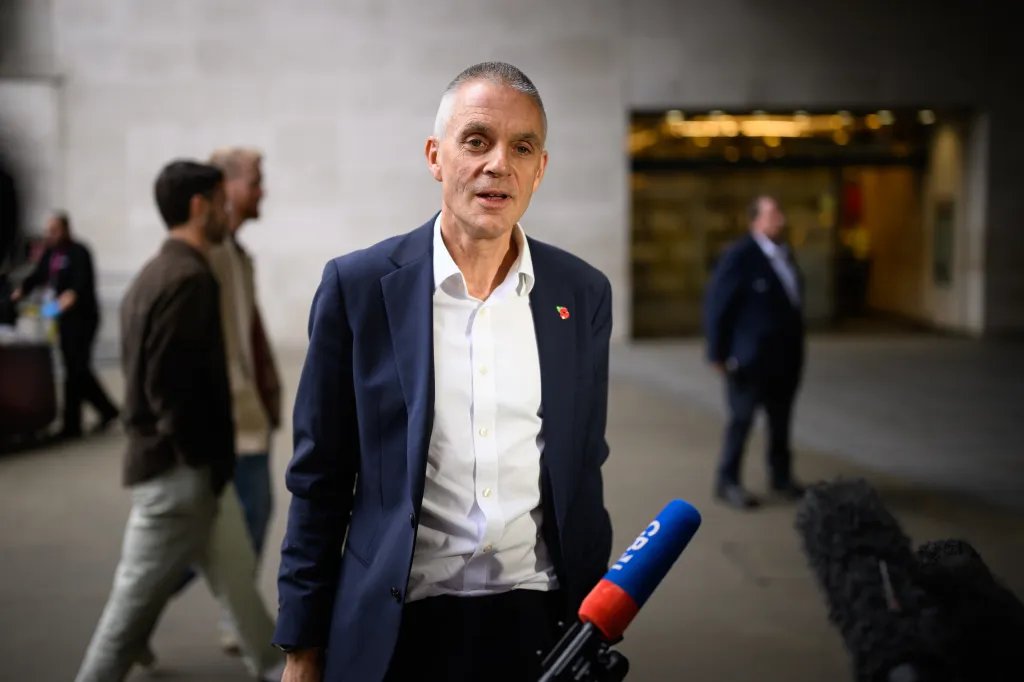
Tim Davie delivered his farewell address today, urging industry leaders to “develop a little bit of swagger” while advocating for the national broadcaster, the BBC.
“Take a swing,” he encouraged. “We are not victims of circumstances. We can shape things.”
With the vital charter renewal on the horizon, which will guide the BBC for at least the next decade, Davie stressed the need to “expend political capital” in negotiations with the government, stating, “This is a choice that will require bravery in my view.”
He emphasized that understanding the Treasury’s stance and the vision from No 10 Downing Street is critical.
Davie identified the “biggest challenge” facing the BBC as economic pressures on households, especially amidst rising living costs. He will depart from the role on April 2.
His remarks were made as the BBC prepares to negotiate future funding for the next decade. According to recent BBC statistics, 94% of the nation utilizes its services, but only 80% contribute to the license fee. Davie pointed out that there are “a number of levers that can be pulled” to address this disparity, which is costing the organization hundreds of millions of pounds annually.
“We are strong but on a knife edge, and decisive action is essential,” he said emphatically. “If we drift and refuse to take risks strategically and politically, we will decline quickly. But despite hurricanes, we have been largely successful. Whisper it quietly, but we have a winner on our hands.”
Davie underscored the urgent need for the BBC to scale up, criticizing a cycle of “short-term deal making and long-term planning” as a response to the “brutal financial situation” the organization has confronted in the past decade.
He lamented “short-sighted” decisions made in recent years, such as granting free license fees to over-75s and cutting government funding for the World Service, which have “reduced the value of the BBC to households and weakened us globally.” He remarked that the turnover of culture secretaries during his 21-year tenure has mirrored that of Director Generals across the BBC’s history, complicating negotiations.
Under his leadership, Davie indicated there had been a “radical redeployment of money and people,” which included 2,000 layoffs and savings of £1B ($1.34B).
He advocated for the BBC to “build scale and be open to new partnerships,” highlighting the growing need for scale in a competitive landscape. “In a world where Netflix and Paramount are feeling the need to bulk up, we have to act urgently to ensure scale,” he noted. “Partnerships like [joint PSB offering] Freely are critical, but we should go further. It makes no sense to have fragmentation in an environment where Netflix and others are looking to scale up.”
Davie suggested it “makes sense” for BBC iPlayer to host rival broadcasters, a concept first floated in the BBC’s recent response to the government’s charter renewal green paper.
He extolled iPlayer, stating that the platform has been “duking it out with Netflix” for years.
Rejecting calls for BBC ownership or a merger with Channel 4, Davie noted that such a move would “reduce UK commissioners.” Instead, he advocated for collaboration in areas like technology to minimize duplication.
Reflective Davie
In a reflective mood during his final appearance before industry peers, Davie prepares to exit an organization where he has contributed for 21 years. He will be succeeded temporarily by Rhodri Talfan Davies, with Matt Brittin, Google’s former head in EMEA, among the candidates for a permanent replacement.
Addressing the audience, Davie shared personal sentiments about the organization he has led, calling for “a little bit of swagger” from its supporters.
“Will your future be defined by your past?” he asked. “Are your best days behind you? I’ve been struggling with this as I give up one of the best jobs on the planet. It’s not an impossible job, but it has not been a breeze… boy, there have been days.”
Looking ahead, he questioned whether “my generation is not used to intervening enough to create enlightened solutions that stimulate civic and commercial return.”
“Many of us in positions of privilege have had a pretty good run, and I can sense I can be a little shy of major change,” he reflected thoughtfully.
As he transitions from his “cherished BBC” and “hands the baton” to Talfan Davies, Davie expressed a forward-looking sentiment. “I am reflecting whether I, an oldish dog, can learn new tricks,” he said.
“Thank you for your support and kindness,” he concluded. “It has meant the world.” He added humorously, “I should resign more often.”