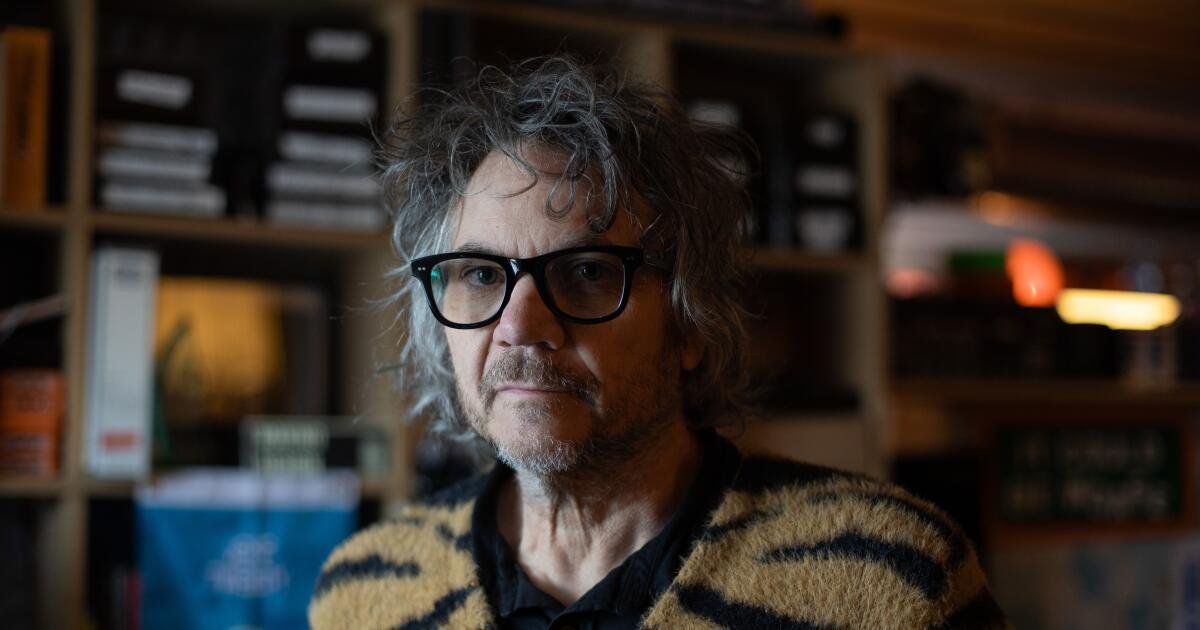
Seeing Beyond the Reflection: Jeff Tweedy’s Personal Insights
Jeff Tweedy recently reflected on the passage of time in his music career, noting, “There’s more time between now and the beginning of my career than there was between the big band era and when my career began.” The frontman of Wilco and a pioneer of alt-country music with Uncle Tupelo in the late 1980s, Tweedy has since expanded the boundaries of American roots rock.
At 58, Tweedy has diversified his artistic portfolio over the past four decades. He has authored three books, produced albums for artists like Mavis Staples and Richard Thompson, and presented a variety show on Instagram during the pandemic alongside his wife, Susie Miller Tweedy, and their two sons, Spencer and Sammy.
Tweedy’s latest work, “Twilight Override,” is a homespun triple album featuring 30 original songs that explore themes of love, travel, music, family, and childhood. Recorded at Wilco’s Chicago studio, The Loft, the album also saw contributions from Spencer and Sammy, along with Sima Cunningham, Liam Kazar, and Macie Stewart. This weekend, Tweedy will perform in Los Angeles, with concerts scheduled at The Belasco on Friday and the United Theater on Broadway on Saturday.
In January, I spoke with Tweedy as he prepared for his annual solo performance at Largo at the Coronet, a venue he has frequented for years to trial new material and share stories. When asked how he feels about Los Angeles, Tweedy replied, “I like everywhere except for Indianapolis… I don’t trust myself to judge any city, to be honest,” he said with a grin.
His son Spencer entered the dressing room, bringing a selection of artisanal energy drinks. Tweedy humorously remarked, “This is really embarrassing — my decadent rock and roll lifestyle with the artisanal energy drink,” explaining his choice for caffeine without coffee due to his anxiety disorder.
As we discussed his performance, I noted his comfort on stage. Tweedy attributed this ease to a long-term acknowledgment of his own awkwardness, stating, “I think the ease you’re referring to is just a comfort with being uneasy.”
The conversation turned humorous when I mentioned David Lee Roth’s energetic presence. “I’d love to be like him,” Tweedy remarked, though added, “It’s too late for him.” He also indicated an admiration for Roth’s confidence, describing it as inspiring.
On the subject of his timing as a performer, Tweedy reflected, “I’ve done a lot of solo acoustic shows,” including many charity performances that featured intimate gatherings with diverse audiences. He noted a turning point when he realized those judging him were often like himself, changing how he approached performances.
Tweedy mentioned the comedic timing of his wife, saying, “She’s the funniest person I know,” recalling instances where she would text him during shows with witty observations about the setlist.
Discussing his dedicated fan base, Tweedy acknowledged the challenge of accepting his status as a musician with such a following. “I’ve accepted that it’s a fact, but I have trouble looking that fact squarely in the eye,” he shared. The pandemic allowed him to connect more directly with fans through “The Tweedy Show,” where he felt a shared experience emerged amid global challenges.
As he reflected on the current state of affairs in America, Tweedy noted, “They sure complain a lot for thinking it’s a glory time,” referring to certain political figures. He expressed frustration at the disconnect between wealth and the struggles faced by many others, asserting, “It appears obscene.”
Looking back at history, he stated, “Every generation has thought it was the end of the world,” underscoring a recurring sense of crisis throughout time.
Tweedy also spoke about working with his sons on “Twilight Override,” emphasizing their individuality and artistic expression. “I’ve tried really hard not to surrender to nostalgia,” he said, acknowledging the importance of embracing new perspectives in music.
He recognized his role as a bridge between musical eras, noting, “There aren’t that many rock bands at this level.” The passing of icons like Tom Petty has led him to consider the ongoing relevance of his work within the evolving landscape of music.
When discussing aging, Tweedy mentioned the invaluable lessons learned from his friend Mavis Staples, who embodies a vibrancy that belies her years. “I don’t think about aging in relation to her,” he remarked, adding that he often forgets his own age when not confronted by physical limitations.
As our discussion concluded, Tweedy delved into the concept of self-identity and its impact on creativity. “The self-image reduces the options, and so the horizon becomes narrower,” he noted, encouraging a view of oneself free from limitations.
Lastly, he shared his newfound appreciation for ABBA’s music, specifically citing his favorite track, “SOS,” and reflecting on his past dismissals of pop music. “The dismissal was the part that wasn’t natural,” he admitted, illustrating a transformation in his musical tastes over the years.