

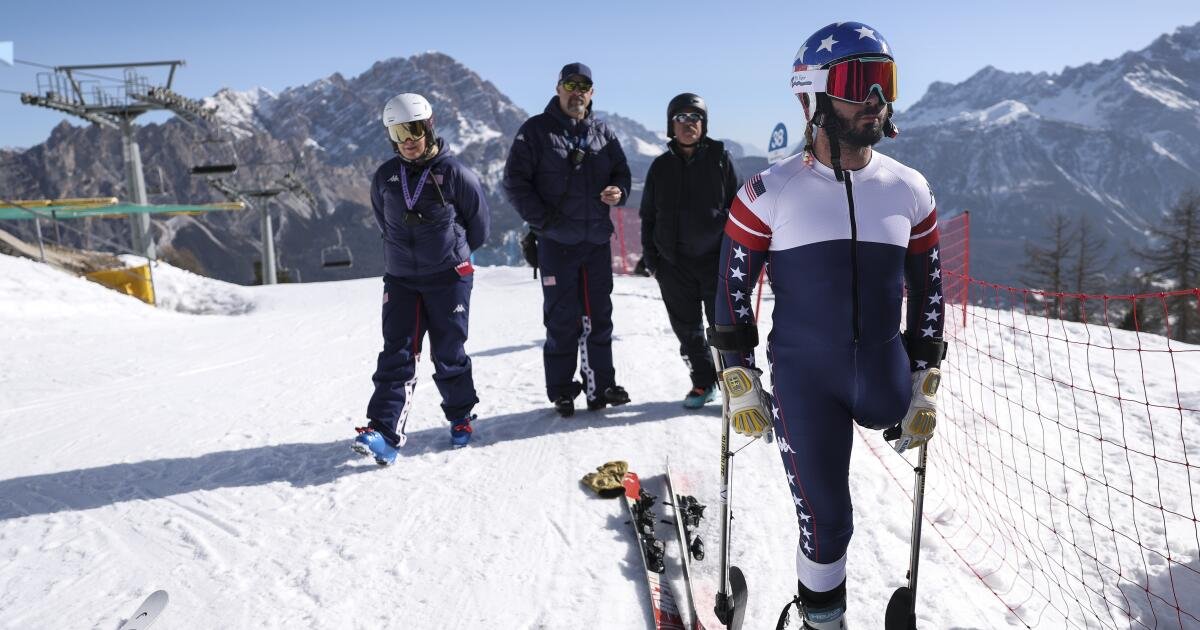
Paralympians Prepare for the Milan-Cortina Games While Navigating Challenges with Iran and Russia
CORTINA D’AMPEZZO, Italy — As the Milan-Cortina Winter Paralympics prepare to officially launch on Friday, athletes are striving to concentrate on their training while navigating troubling global events. This is the first major international sporting event since the escalation of tensions in the Middle East began last week.
A significant point of contention among the participants is the reinstatement of the Russian flag in this global arena, leading to some nations announcing their intention to boycott the opening ceremony in protest.
The Games, which coincide with the 50th anniversary of the Winter Paralympics, are unfolding against the backdrop of ongoing military actions involving the United States, Israel, and Iran. These conflicts have resulted in flight disruptions affecting several nations trying to reach Italy. While Iran was expected to send one skier, his participation remains unconfirmed.
Laura Dwyer, a U.S. wheelchair curler, emphasized the athletes’ focus on competition despite the external turmoil. “We are here to do a job,” she told the Associated Press on Thursday. “We’re working really hard to show up, and represent.” Dwyer, alongside her mixed-doubles partner Stephen Emt, expressed determination to maintain their focus on the games ahead.
The curling events commenced two days prior to the opening ceremony, prompting British curler Jo Butterfield to reflect on the broader implications of the ongoing conflicts. “To be honest, I don’t really think about it,” she said. “I’m a firm believer that sport can rally people, and hopefully some good news stories on the back pages will help the public be happy.”
The politically charged atmosphere is further complicated by the boycott of countries like Ukraine, which announced its withdrawal from the opening ceremony in response to the return of Russian athletes under their own flag for the first time in over a decade. Several additional nations, including Czechia, Estonia, Finland, Latvia, Poland, and Lithuania, are expected to join this boycott, citing solidarity with Ukraine.
Latvian curler Polina Rozkova articulated her team’s stance: “It’s not allowed (to have a) country under their own flag when their country is attacking another country.” Estonian curler Katlin Riidebach echoed these sentiments, highlighting the need to make a political statement regarding the ongoing war.
In a recent assessment, the International Paralympic Committee (IPC) took action against a specific item of Ukraine’s uniform that contained a map deemed politically sensitive. The IPC engaged in dialogue with the Ukrainian National Paralympic Committee, resulting in an alternative uniform being approved swiftly.
As the Games progress, the intersection of sports and politics remains a focal point, reminding all participants of the larger challenges faced in the world today.