Palestine ’36’ Review: A Thoughtful Look at Historical Tensions in the Middle East by Annemarie Jacir
Annemarie Jacir’s period drama, *Palestine ’36*, is set to debut in the U.S. a month after its noteworthy reception at the BAFTAs, where star Robert Aramayo triumphed over celebrated actors Leonardo DiCaprio and Michael B. Jordan to win the Best Actor award. Those curious about how the *Game of Thrones* actor achieved such a surprising victory may have to await the film’s release in America to find out. In *Palestine ’36*, however, Aramayo’s talents are somewhat overshadowed by an ensemble cast in a film that, despite its ambition, does not fully coalesce.
In a twist of irony, as the situation in the Middle East continues to evolve, several filmmakers have sought to explore its historical roots. This began in 2022 with Darin J. Sallam’s *Farha*, followed by Michael Winterbottom’s *Shoshana* in 2023—premiering a month before the tragic events of October 7. Last year, Cherien Dabis’s epic *All That’s Left of You* even made the Oscar shortlist.
<pPalestine ’36 emphasizes the perspectives of the innocent, a trend mirrored in the aforementioned films. However, this focus complicates the narrative, as viewers are limited to the knowledge of the characters. While this approach works in outdoor settings, it poses challenges when the story shifts to Jerusalem’s intricate political landscape.
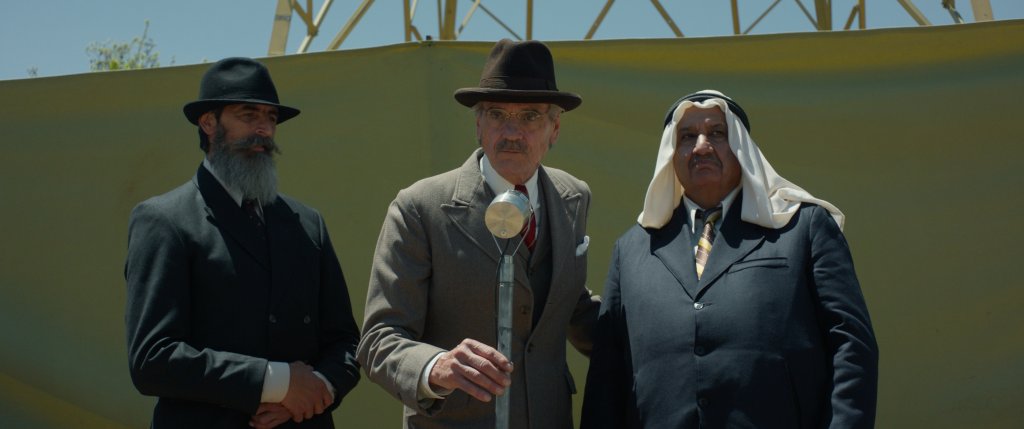
The film’s title references a pivotal year not only for Palestine but for the world, amid the brewing European conflict and the turmoil surrounding Britain’s King Edward. Starting with the British Mandate, the film portrays the influx of Jewish settlers into the region. Early scenes depict High Commissioner Arthur Wauchope (Jeremy Irons) establishing a radio broadcast, highlighting his hesitance to confront terrorism—a decision later recognized as consequential.
Viewers encounter the Arab perspective through Yusuf (Karim Daoud Anaya), a rural boy who balances life between his village, where cotton is cultivated, and Jerusalem, where he manages errands for a newspaper editor and his vehemently anti-Zionist wife. Tensions arise when settlers encroach upon the villagers’ land, culminating in violence when one elder is shot, leading the British to side with the settlers.
The narrative unfolds through a series of reactions: villagers become sympathetic to local revolutionaries, while the urban Arab elite finds itself divided, creating rifts within both the business and intellectual communities.
The British factions, too, are depicted as deeply split, with diplomat Thomas Hopkins (Billy Howle) at odds with Army Captain Orde Wingate (Aramayo), seen as a foundational figure of the modern IDF. Notably, police officer Charles Tegart (Liam Cunningham) delivers prophetic commentary, stating, “We don’t need another Ireland on our hands.”
As the story progresses, headlines from the wider world serve as a backdrop, referencing significant events such as The Balfour Declaration and the forthcoming Peel Commission, which would eventually advocate for partition. While the film demonstrates a commendable level of intelligence, its visual storytelling often falls back on established tropes of cyclical violence. It features recurring motifs, such as a young boy wielding a weapon and a girl who manages to see a glimmer of hope amidst despair.
As a historical account, *Palestine ’36* offers a thoughtful exploration of a complex narrative, although it presupposes some prior knowledge and may leave viewers wanting more nuance. It succeeds as an attempt to illuminate a challenging topic.
Title: Palestine ’36
Director-screenwriter: Annemarie Jacir
Cast: Karim Daoud Anaya, Hiam Abbass, Saleh Bakri, Robert Aramayo, Yasmine Al Massri, Billy Howle, Dhafer L’Abidine, Ward Helou
Distributor: Watermelon Pictures
Running time: 1 hr 41 mins