
Iran’s Cinema: Four Directors Share Insights on Its Journey and Future
The Iranian Revolution of 1979 marked a seismic shift in the country’s political landscape, toppling the US-backed Shah Mohammad Reza Pahlavi and establishing an Islamic Republic led by Ayatollah Ruhollah Khomeini. This regime change had immediate repercussions for the filmmaking community, decimating the filmfarsi industry, known for its low-budget productions and Western influences. Despite these challenges, Iranian cinema has persisted, producing internationally acclaimed directors such as Abbas Kiarostami, Mohsen Makmalbaf, Jafar Panahi—winner of last year’s Palme d’Or—and Asghar Farhadi, who returns to Cannes this year with his latest French-language film, Parallel Tales.
Iranian director Asghar Farhadi’s Competition entry Parallel Tales.
THE PAST
FATEME AHMAD
As director Fateme Ahmadi remarks, “There is a misconception about Iranian cinema because of the distorted image of Iran in the media. People think we ride camels. They think we all live in villages. But Iran is one of the very few countries in the world where there is no illiteracy. The rate of illiteracy is near zero; 67% of students in higher education are women.” She highlights that women in Iran actively participate in society, noting, “Women vote, women drive, women are highly educated. And then 25% of filmmakers in Iran are women. In America, it’s 4%. Women filmmakers are really celebrated and cherished in Iran.”

Fateme Ahmad
Ahmadi, hailing from Shiraz in southern Iran, studied filmmaking at the Tehran University of Art and also holds degrees in Persian literature and linguistics. Currently finalizing her debut feature, Daughter of Eden, featuring Hiam Abbass, she recognizes the complexities of the Iranian regime, stating, “The Islamic Republic of Iran may be many things – repressive and reactionary, to put it mildly – but it is anything but stupid.”
Ahmadi emphasizes Iran’s rich cinematic tradition, recounting her upbringing with VHS copies of filmfarsi and drawing inspiration from art cinema that the regime allowed. “You don’t need to censor Tarkovsky or Bergman much,” she explains. “Soviet cinema was also a source of inspiration… I watched Mirror by Tarkovsky when I was 12. I didn’t understand anything!”
The influence of Bollywood and the French New Wave also shaped Iranian filmmakers in the 1950s and 60s, with figures like Ebrahim Golestan and Fereydoun Jeyrani becoming pioneers of the Iranian New Wave. “I would say it’s still the same pretty much,” Ahmadi reflects, noting the coexistence of official and underground cinema in Iran.
THE PRESENT
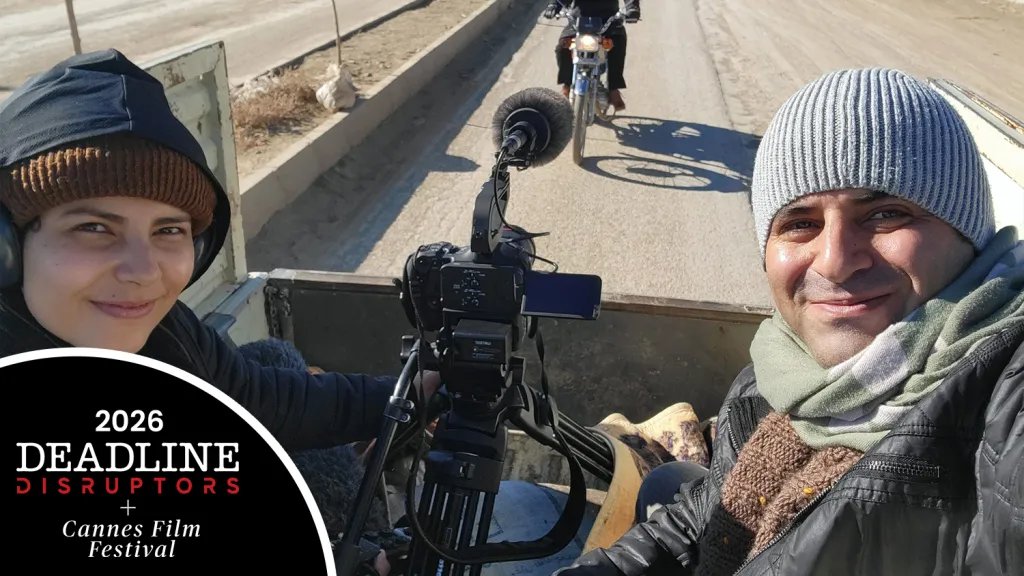
SARA KHAKI and MOHAMMADREZA EYNI
“Cinema is the only way for people to talk about the ordinary people of Iran,” asserts director and producer Mohammadreza Eyni. “This is the strength of Iranian cinema. It’s not just about the stories or the poetry of the films; it’s also an act of resistance in advocating for a culture, a very rich culture.” Their film, Cutting Through Rocks, premiered at Sundance last year and progressed to the Oscars.
‘Cutting Through Rocks’
“When I was growing up in Tehran, I witnessed so many incredible women like Sara,” Khaki recalls. However, their journey has not been without challenges, facing obstacles related to travel and visas as they navigated the film festival circuit, particularly during tumultuous political times.
Eyni describes the tension of a particularly notable Oscars night, characterized by geopolitical tensions involving Iran. “There was an article saying that the presence of two Iranian filmmakers made it ‘more sensitive.’” Reflecting on the experience, he notes, “We really envied the other nominees… Yes, we were there bringing a film from our country, but our country didn’t have the internet, and everyone was under a lot of pressure.”
THE FUTURE
Pegah Ahangarani, once known for her role in Abbas Kiarostami’s 2008 film Shirin, is now making her mark behind the camera. At this year’s Cannes, she will debut her documentary Rehearsals for a Revolution—a personal exploration of her journey from Iran to London.
Pegah Ahangarani
Ahangarani, now living in London, reflects on her transition from acting to filmmaking. “I hated acting,” she admits. “But when I came to London, I decided to stick to it and become a filmmaker.” Her upcoming work takes a deep dive into her life experiences, portraying the vibrant narrative of Iranian history intertwined with her personal story.
“Whatever happens in Iran, I hope that it keeps empowering the people,” she expresses. “Because Iranian people need to be their own masters. They never give up.” Ultimately, she contemplates the enduring spirit of Iranians: “I think we all need to live in a fictional, dream-like reality, and cinema is the best way we found to give body to it.”