
A Journey of Heart: An Amerasian Man’s Search for His American Father From Wartime Vietnam
The plight of Amerasian children fathered by U.S. soldiers during the Vietnam War remains a poignant chapter in history. Estimates of their numbers range from 100,000 to potentially half a million, reflecting a significant impact of U.S. military involvement in Vietnam.
Following North Vietnam’s victory, many of these children faced societal discrimination. They became symbols of the U.S. military’s controversial actions, with their mothers often stigmatized for having “fraternized with the enemy.”
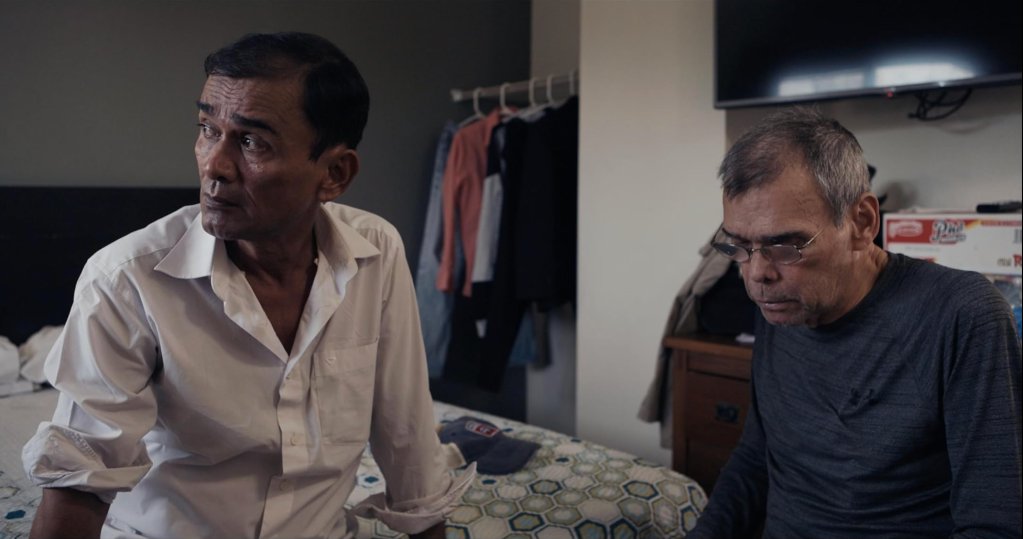
Many of these Amerasian children were left without knowledge of their fathers. The Oscar-contending documentary Child of Dust explores the journey of Sang Ngô Thanh, a man fathered by an American G.I. in the 1960s. Using DNA testing—a resource that has only recently become available—Sang found hope in the possibility of connecting with his father.
Cinematographer Mikael Lypinski and director Weronika Mliczewska attend the 2025 Tribeca Festival on June 7, 2025 in New York City.
Directed by young Polish filmmaker Weronika Mliczewska, the documentary captures her realization of the complex emotional landscape surrounding these children. Mliczewska discovered during her work in Vietnam that the father figure holds significant cultural importance, often shaping a person’s identity.
Watch on Deadline
“In Vietnam, the father figure is so important that it is actually building the whole identity for you,” Mliczewska explained at a recent Q&A session at the Museum of Tolerance in Los Angeles. “I met Amerasians and there was one recurring thing in all the interviews while doing my research — all of them were very emotional about their missing father, about the father they never knew. And that was very idealized due to the Vietnamese culture, but yet this father also made them suffer for all their lives.”
With assistance from an organization specializing in DNA testing for Amerasians, Sang was able to connect with his father, Nelson Torres, who was then in his 80s and living in a Southern U.S. state. Sang learned he also had three half-siblings. Their initial reconnection over Skype proved to be an emotional moment, setting the stage for a planned meeting in the U.S.
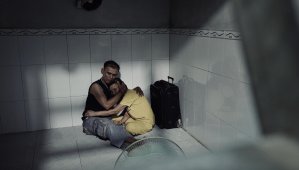
Sang Ngô Thanh, his bag packed, embraces his wife.
For Sang, such a journey meant an emotional departure from his family, including his wife, daughter, and young grandchild. Mliczewska recounted a conversation she had with him before his departure, expressing concerns and asking if he was ready to take the flight. Sang affirmed the importance of the journey, stating, “That was my biggest dream to meet my father and to hug him. I have to do it in order to bring all my pieces of my identity together.”
Mliczewska emphasized Sang’s desire to share his story. “He wanted his voice out [for the] first time in his life,” she noted, underscoring her commitment to telling his story effectively.
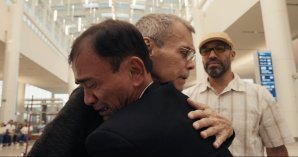
Sang Ngô Thanh hugs his father, Nelson Torres. Looking on is Sang’s half-brother.
In stark contrast to many former G.I.s who avoid contact with their children from Vietnam, Torres expressed genuine affection for Sang’s mother. Mliczewska highlighted Torres and his American-born children’s motivations to participate in the film: to represent veterans’ acceptance of their offspring and to set an example.
The film, produced by Mliczewska along with Vietnam-based producer Chi Minh De Leo, later welcomed American filmmaker Bao Nguyen, a child of Vietnamese immigrants, to the project. Nguyen initially held reservations about the film due to its intimate subject matter but was impressed by Mliczewska’s sensitive approach.
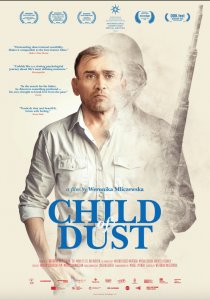
Child of Dust has garnered accolades from film festivals worldwide, including the Audience Choice Award at the Chicago International Film Festival, three awards at the Krakow Film Festival, and Special Mention at the Thessaloniki International Documentary Festival. Despite its success, the film has faced challenges, particularly in Vietnam, where it has not yet screened due to censorship issues.
Mliczewska reported ongoing efforts to bring the film to Vietnam, emphasizing the difficulty of addressing the sensitive history surrounding Amerasians. “Nobody would touch this topic in Vietnam,” she observed.
Nguyen added, “The way that Amerasians were treated post-war is very delicate, and any subject matter related is flagged immediately. We hope that reconciliation can happen, and conversations around this topic are necessary.”
Mliczewska concluded, “Hopefully we can gain traction outside of Vietnam and then that will lead to our last step.”