
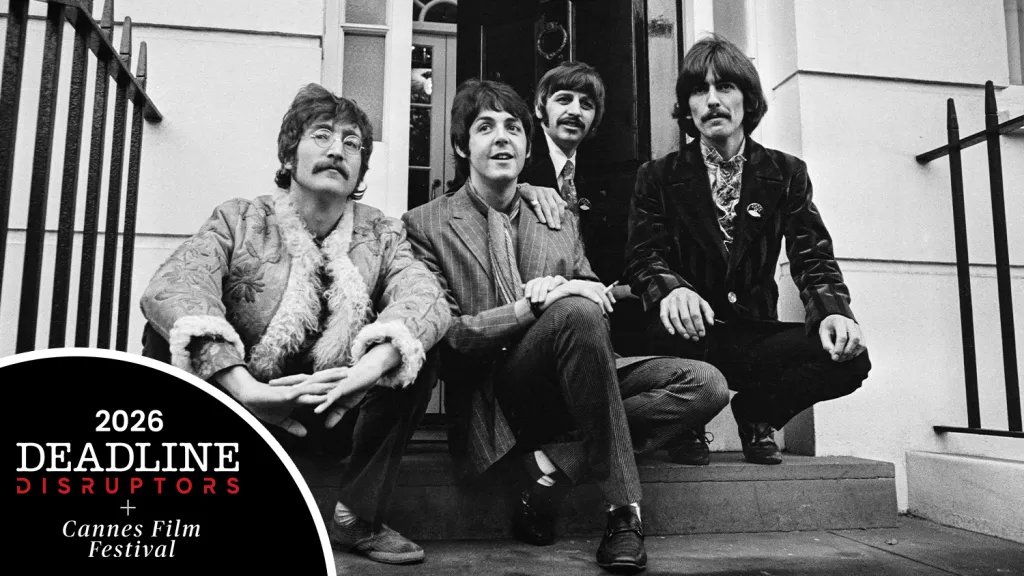
The Beatles in Cannes: Cherished Moments of John, Paul, George, and Ringo at the Festival, Not As a Band
Picture yourself in a boat on the Riviera… Throughout the history of the Cannes Film Festival, many rock superstars have been drawn to its allure. The Rolling Stones graced the event in 1971 with Gimme Shelter and again in 2010 with Stones in Exile. The Who closed the festival in 1975 with their rock opera Tommy, while Pink Floyd showcased The Wall in 1982. U2 promoted their 2007 film U2 3D with a performance on the steps of the Palais. Notably, all four members of The Beatles attended Cannes at different times but never together—a curious twist given their significant connection to film. This anomaly may find resolution with Sam Mendes’ upcoming project, The Beatles – A Four-Film Cinematic Event, scheduled for release in April 2028, just weeks before the festival.
The Beatles’ cinematic journey began with their celebrated film, A Hard Day’s Night, released in the summer of 1964. This followed the global phenomenon of Beatlemania that emerged in late 1963 after their debut single, “Love Me Do.” Movies quickly became vital to music marketing, a path paved by Elvis Presley. Initially, The Beatles considered an offer from manager Brian Epstein to star in the pop-tinged sexploitation film The Yellow Teddy Bears (1963), but ultimately declined.
Watch on Deadline
“We said to Brian, ‘Yeah, OK, great!’,” Paul McCartney recalled. “Then he came back to us after talking to the producers and told us they wanted to write the songs themselves.” Naturally, they passed.
In the summer of 1963, The Beatles signed a three-picture deal with United Artists, quickly agreeing on Richard Lester as their director. Having previously directed the musical comedy It’s Trad, Dad!, he was remembered by McCartney and John Lennon from a short film they admired called The Running Jumping & Standing Still Film (1959). The resulting film was a light comedy and an insightful look at the pressures of pop culture, depicting a 36-hour stretch in the lives of the band as they prepared for a TV appearance.
With a modest budget of £180,000, filming commenced in March 1964 and wrapped in less than two months, leaving just over three weeks for editing and final preparations before its London premiere on July 6. Surprisingly, the film became a blockbuster, prompting Lester to create a sequel that premiered less than a year later: Help!, a farce featuring Ringo Starr receiving a sacrificial ring from a fan.
The band produced only three more films, primarily to fulfill contractual obligations. Magical Mystery Tour (1967), which they directed, was a whimsical 52-minute TV special that largely fell flat. Yellow Submarine (1968), while visually inventive, featured minimal input from The Beatles, who did not even voice their characters. Their final film, Let It Be (1970), was a somber documentary that would have sufficed as their last word had Peter Jackson not revisited the footage for his 2021 mini-series Get Back.
John Lennon and Yoko Ono in Cannes.
JOHN
This year, one of the founding Beatles returns to Cannes with Steven Soderbergh’s documentary John Lennon: The Last Interview, utilizing a radio interview Lennon gave on December 8, 1980, the day of his assassination. Lennon made his first Cannes appearance in May 1965, accompanying Richard Lester, who was competing with The Knack… and How to Get It. At that time, Help! was ready for release, and Lennon engaged in a quirky interview on The Merv Griffin Show, chiefly to promote his book, A Spaniard in the Works, sold for “ten shillings and sixpence.”
Lennon and his then-wife Cynthia spent four days at the festival, mingling with attendees including actor Michael Caine. An amusing moment arose when neither of them was recognized at a party hosted by the British Consul.
“He introduced himself as Joe Lemon and I used my real name, Maurice Micklewhite,” Caine later recounted. “As each group approached us, we introduced ourselves, and when they asked us what we did for a living, John would point at me and say, ‘I’m his assistant,’ and I in turn would point at John and say, ‘I’m in charge of him.’”
The evening turned into a memorable night when both actors got intoxicated at another party. Seeking a bathroom, only Caine succeeded, while Lennon opted for an open window, resulting in a mess. Caine described the incident humorously in his autobiography, noting Lennon’s nonchalance: “John finally finished… ‘They’re rich,’ he replied. ‘F*ck ’em.’”
By 1971, Lennon returned to Cannes transformed. He wore denim instead of a tuxedo for the premiere of Apotheosis, a short film he collaborated on with Yoko Ono. The film depicted the couple entering a hot air balloon and vanishing into the clouds for 18 minutes before resurfacing. It was shown alongside Ono’s Fly, featuring a slow-moving fly across a naked actress—an unconventional pair of offerings.
This appearance marked a significant moment in Lennon’s post-Beatles career; he was seen promoting his album John Lennon/Plastic Ono Band and Ono’s book Grapefruit, which includes unconventional and surreal epigrams.
Paul McCartney on stage.
PAUL
Despite his artistic inclinations and a well-documented passion for painting, Paul McCartney has largely kept a distance from films. His notable appearances have mainly been as himself, aside from a cameo in the low-budget 1987 comedy Eat the Rich. His first Cannes visit was with wife Linda, who produced an animated short in 1980, Seaside Woman, which won the short film Palme d’Or.
This success encouraged McCartney to venture into feature films with Give My Regards to Broad Street (1982), which followed a fictional day in the life of a rock star facing financial woes. Critics were less than kind; Roger Ebert gave it one star and labeled it a throwback to less sophisticated pop musicals.
Reflecting on the experience, McCartney acknowledged the sting of negative reviews. “Nobody likes to have their wrists slapped,” he admitted, comparing it to poor test results in school. “It also happened with Magical Mystery Tour. Now, there are a lot of people who like it.”
Returning to Cannes in 2001, three years after Linda’s death, McCartney promoted a Wings concert film titled Wingspan. During a press conference, he shared insights on diverse topics, including foot and mouth disease and songwriting. Most notably, he dismissed the possibility of a Beatles reunion, stating, “There’s three Beatles left, and it would be a real problem to be on stage and look over where John used to be.” Tragically, George Harrison passed away just six months later.
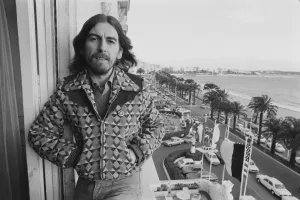
George Harrison on his balcony at the Carlton Hotel overlooking the Croisette in Cannes.
GEORGE
The first among The Beatles to engage with film soundtracks, McCartney collaborated with producer George Martin on the score for the 1966 comedy-drama The Family Way. Meanwhile, George Harrison was the first to release a solo work, comprising music for the 1968 film Wonderwall. This film, an avant-garde take on a midlife crisis, followed a repressed scientist spying on his attractive neighbor.
Harrison’s exploration of Eastern spirituality manifested in his work on Wonderwall. Director Joe Massot allowed him significant creative freedom, leading Harrison to Bombay’s EMI studios to fuse classical Indian instruments with Western music styles, a precursor to what would later be termed World Music.
Although Wonderwall premiered at Cannes outside the official selection, it faced unfortunate circumstances—closely following a scandal involving The Beatles and their former guru, Maharishi Mahesh Yogi. Due to this backlash and the festival’s cancellation on the day of its screening, the film was deemed a flop.
“It’s nice to let people have as much artistic freedom as possible, but I’m the one who has to pay back the bank,” Harrison later remarked about his transition into producing.
In 1978, Harrison showcased his business acumen by financially backing Monty Python’s Life of Brian after its original distributor withdrew due to controversy. Harrison mortgaged his home to co-found HandMade Films and support the project. He later described the endeavor as both a risk and an expression of his admiration for Monty Python.
The output of HandMade Films predominantly leaned toward comedy and, with few exceptions, did not fit the Cannes aesthetic. However, Harrison found satisfaction in the role. “When I was acting, there was always the feeling that the artists were the clever ones who do everything—and then there were these horrible people who put the money up and don’t know anything,” he noted, reflecting on his dual perspective as a musician and producer.
Ringo Starr with director Roman Polanski at the Cannes Film Festival.
RINGO
Ironically, while Lennon was expected to make the biggest splash in film, it was Ringo Starr who developed a passion for acting early on. “I loved the movies as a kid,” he recalled, expressing childhood memories of immersing himself in various film genres. Yet, his journey in cinema began slowly with adaptations of Terry Southern’s literature, which received mixed reviews.
Starr’s forays into film included appearances in Candy, dubbed a “shambles of a sex spoof,” and The Magic Christian, which humorously engaged with social dynamics. Despite the mixed receptions, his experiences continued to evolve, leading to a role as a prehistoric man in Caveman.
Starr’s cinematic journey included a bizarre collaboration with Harry Nilsson in the 1974 production Son of Dracula, where he played Merlin. In subsequent roles, he portrayed the Pope in Lisztomania and appeared alongside significant figures like Tony Curtis in Mae West’s last film, Sextette. Ultimately, his most notable performance came in That’ll Be the Day, where he played a greaser in a drama featuring a vintage jukebox soundtrack.
Following his premiere at Cannes with George for Wonderwall, Starr returned to the festival in 1982 with The Cooler, a short film made up of three songs from his album. Directed by Lol Creme and Kevin Godley, it depicted Starr in a futuristic Western prison where the guards were dressed in stylized military attire. Although it did not receive accolades, Starr’s cheerful acceptance of his presence was evident. “First and foremost, I am a drummer,” he asserted. “But I didn’t start playing drums to make money.”