

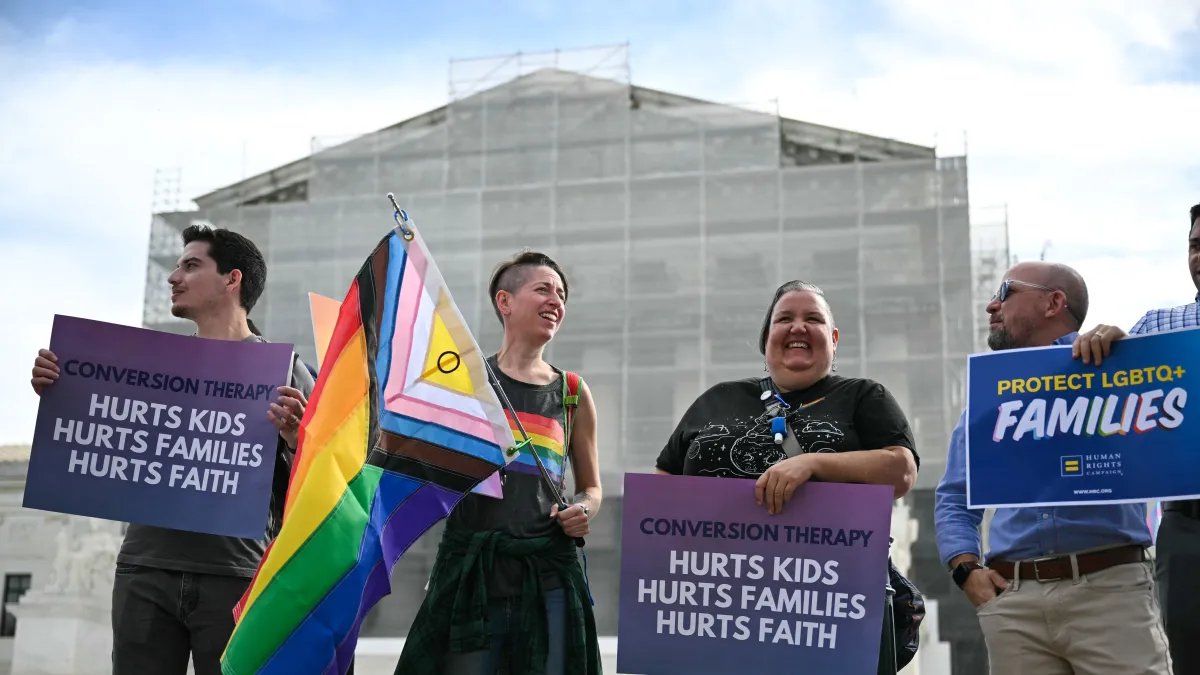
How the Supreme Court’s Decision Against Conversion Therapy Affects California
California’s LGBTQ Community Reacts to Supreme Court Ruling on Conversion Therapy
In a significant ruling on Tuesday, the Supreme Court struck down Colorado’s law prohibiting licensed mental health professionals from practicing conversion therapy on minors. This decision has left California and national LGBTQ communities expressing disappointment and concern.
Conversion therapy, also known as reparative therapy, seeks to change an individual’s sexual orientation or gender identity through various methods. Critics argue this practice inflicts shame and isolation, leading to severe mental health repercussions such as Post-Traumatic Stress Disorder (PTSD), depression, and suicidal thoughts.
Terra Russell-Slavin, chief strategy officer for the Los Angeles LGBT Center, emphasized the long-lasting damage caused by conversion therapy. "It leads to higher risk of substance use, homelessness, family disconnection, suicidality," she stated. "These are not small things that a person has to deal with. There’s a reason we have fought for decades to get this care banned."
A broad consensus among medical organizations, including the American Medical Association and the American Psychological Association, opposes reparative therapy. However, supporters such as David Pickup from the Alliance for Therapeutic Choice and Scientific Integrity assert that the Supreme Court ruling highlights concerns regarding censorship of therapists’ speech based on their viewpoints. "To rob clients of adults or minors of their free speech rights and therapy that does work for them is just unconstitutional," said Pickup.
The ruling arrives amid efforts in California to provide additional support to victims of conversion therapy. State Senator Scott Wiener introduced a bill, SB 934, aimed at extending the statute of limitations for survivors to file malpractice suits against therapists. Wiener remarked, "Conversion therapy is psychological torture, and California will always stand strong with LGBTQ youth to protect them from the extremist movement to harm them."
Notably, Casey Pick, Senior Director of Law and Policy for the Trevor Project, clarified that the Supreme Court’s decision does not impact SB 934, as it addresses regulatory issues, not the safety or legality of conversion therapy itself. "Conversion therapy, even after today’s decision, is still medical malpractice. It is still consumer fraud," Pick asserted.
It’s crucial to note that the Supreme Court ruling does not permit conversion therapy in California, which was the first state to ban the practice. Pick explained, "What it did was reverse a lower court decision and remand it back to the lower court, saying, ‘You need to apply a heightened level of scrutiny when you look at this fall. We think that this is a First Amendment case, that it is about free speech.’"
Both Pick and Russell-Slavin have witnessed the damaging effects of conversion therapy on LGBTQ youth firsthand. "What’s really perverse is folks who find it really hard to seek out help from mental health providers because of the betrayal at the hands of somebody who held a government-issued license," Pick noted.
Russell-Slavin extended an invitation for conversion therapy victims to seek assistance at the Los Angeles LGBT Center, which offers trauma-informed mental health services for the community.
Meanwhile, the Trevor Project is gathering signatures for a petition urging state lawmakers to take actions similar to those proposed by Senator Wiener to safeguard LGBTQ+ youth from conversion therapy practices.